

In the last five years India’s beauty scene has been a thrilling show: viral product launches, micro-influencer love affairs, and storefronts plastered with aspirational ads. Yet, for several household D2C names, the headline reads like a paradox, fast early growth followed by falling revenue and ballooning losses. Take Sugar Cosmetics: what looked like a category leader saw revenue stall and then fall in FY25, while losses widened.
That pattern: quick virality, expensive expansion, and then a hard ceiling, is not an accident. Across brands as varied as Mamaearth (Honasa), Sugar, WOW, Juicy Chemistry and Arata, you can trace the same arc:
Traction online
Expensive marketing and discount-driven customers
A costly push offline
Working-capital stress and shrinking margins.
The important question is not only what happened, but what a product manager can do about it. This case study maps the common failure modes, shows the handful of playbook moves that actually move unit economics, and gives precise experiments PMs can run to test if their brand is on the same path — and how to reverse it.
Brands in focus:
This piece focuses on five representative Indian beauty brands that followed the D2C trajectory: rapid brand-building online, then attempting to scale offline and broaden categories:
Mamaearth / Honasa Consumer : a poster-child D2C brand that scaled quickly with ingredient-led storytelling and then expanded aggressively into offline retail. In FY25, Honasa’s revenue grew, but profits declined meaningfully (management commentary and filings show material profit compression).
Sugar Cosmetics : built strong youth-focused positioning and influencer-first demand but reported a revenue decline and margin stress in FY25 as retail expansion and marketing costs weighed on the P&L.
WOW Skin Science (and peers like Arata, Juicy Chemistry) : smaller-to-mid players with strong niche positioning (natural/ayurvedic) who face the same pressure when trying to scale beyond their core affluent urban customers.
Minimalist : a counterexample: a tightly product-led play that scaled to an ARR in the ~₹500 crore range and attracted acquisition interest; it’s an example of how product + supply fundamentals can deliver profitable scale.
Growth mode: Digital-first → influencer-led discovery.
Common inflection: Heavy marketing + offline expansion.
Short-term result: Revenue bump, higher CAC, deeper losses.
Longer-term risk: Store closures, inventory write-offs, investor pressure.

The Growth Ceiling
A recurring lifecycle emerges when you map traction to unit economics:
Seed traction online. The brand uses social content, creator reviews and D2C funnels to reach an early (often millennial/Gen-Z) cohort. Social virality and trend-based formulations drive trial.
Rapid growth and category expansion. Motivated by opportunity and investor capital, the brand expands its catalogue (haircare, skincare, bodycare), invests heavily in marketing, and experiments with quick commerce and marketplaces.
Bidding war for attention. As hundreds of D2C brands bid for the same ad inventory and creator minutes, CAC increases. The platforms’ algorithms favour low-cost conversions, which often result in acquiring bargain-hunting customers who churn after the discount.
Offline expansion to chase scale. With digital penetration limited and premium customers still purchasing offline or through premium retailers, brands are expanding into retail chains, pharmacies, and franchise stores. However, this offline approach brings distributor margins, returns, longer credit cycles, and the logistics costs of managing shelf life and regional demand.
Working-capital squeeze + product sameness. High levels of unsold or returned inventory, coupled with only incremental differentiation vs competitors, make repeat purchase rates low and per-customer lifetime value (LTV) insufficient to recover CAC. Once cash burn becomes unsustainable, brands retrench: stores close, promotional intensity increases, and headline growth reverses.
Root-Cause deep-dive
1. The Illusion of Differentiation
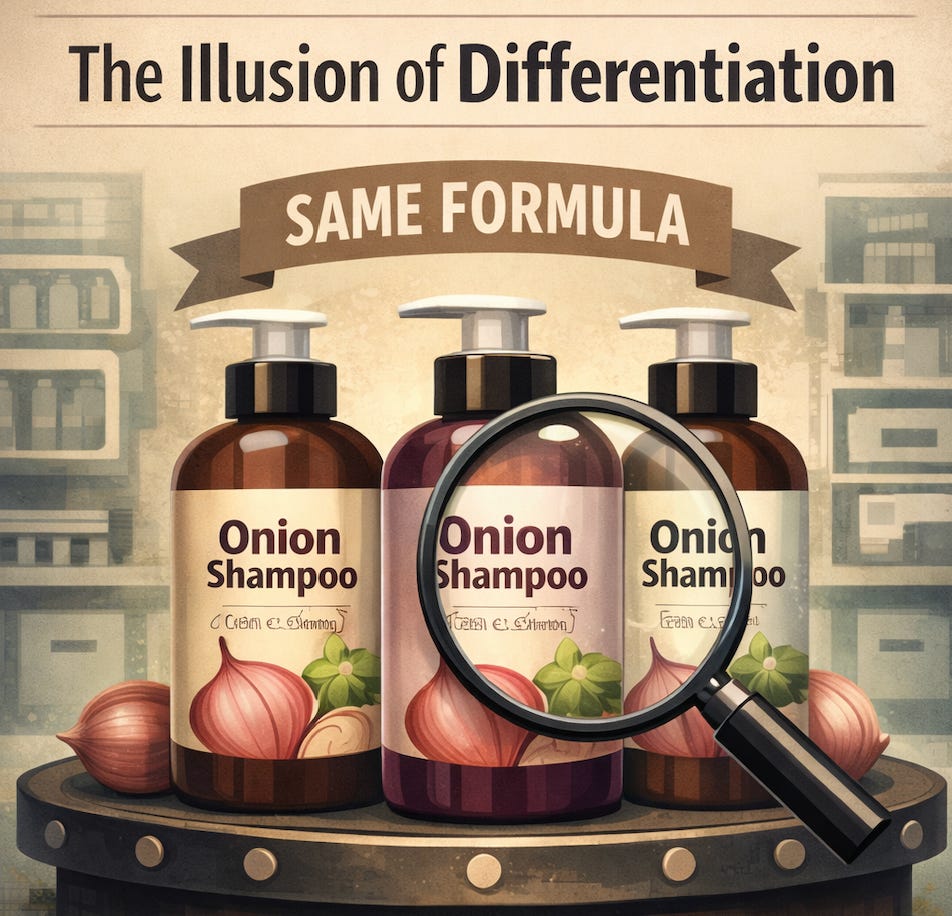
The problem. Early D2C winners often sell what looks different (clean labels, Instagram-friendly packaging, “hero” ingredients), but behind the packaging, many formulations are similar. The contract-manufacturing ecosystem in India supports fast new launches, and there are hundreds of CMOs that will create similar formulations quickly and cheaply. That means new brands can look novel at launch but are easy to copy or replicate, leaving the ‘moat’ superficial.
Evidence & mechanics. Industry reporting shows hundreds of contract manufacturers in the Indian BPC ecosystem, and examples of the same manufacturers producing SKUs for multiple brands. The consequence: ingredient trend-chasing (vitamin C, niacinamide, onion oil, exfoliating acids) leads to many SKUs feeling substitutable to consumers.
Why PMs should care. When products are substitutable, a customer who tries you during a sale can easily switch next month if another brand offers a discount or a flash sale. That kills repeat purchase rates and compresses LTV.
What to probe?
Ingredient & formulation audit: Are your hero claims achievable only by your formula? Can a competitor replicate in 4-8 weeks?
Manufacturing exclusivity: Do you have contracts that prevent your exact formula/pack from being sold to others?
Real-world differential tests: Blind sensory tests, retainability studies (do users perceive not just marginal differences but meaningful ones after 30/60 days?).
Micro-niche focus: Is there an underserved ‘need’ (hard water scalp, humidity-triggered acne, pigment-specific foundation) you can solve with credible science rather than just packaging?
Tactic Steps: Make at least one SKU your strategic moat, own the ingredient, the application format (e.g., time-release serum), or the packaging that changes user behaviour (metered pump, single-dose refill). Prove repeatability and demonstrable benefits through trials and independent lab results. Those signals drive higher consideration and, crucially, better retention.
2. Offline Distribution: The Silent Margin Killer
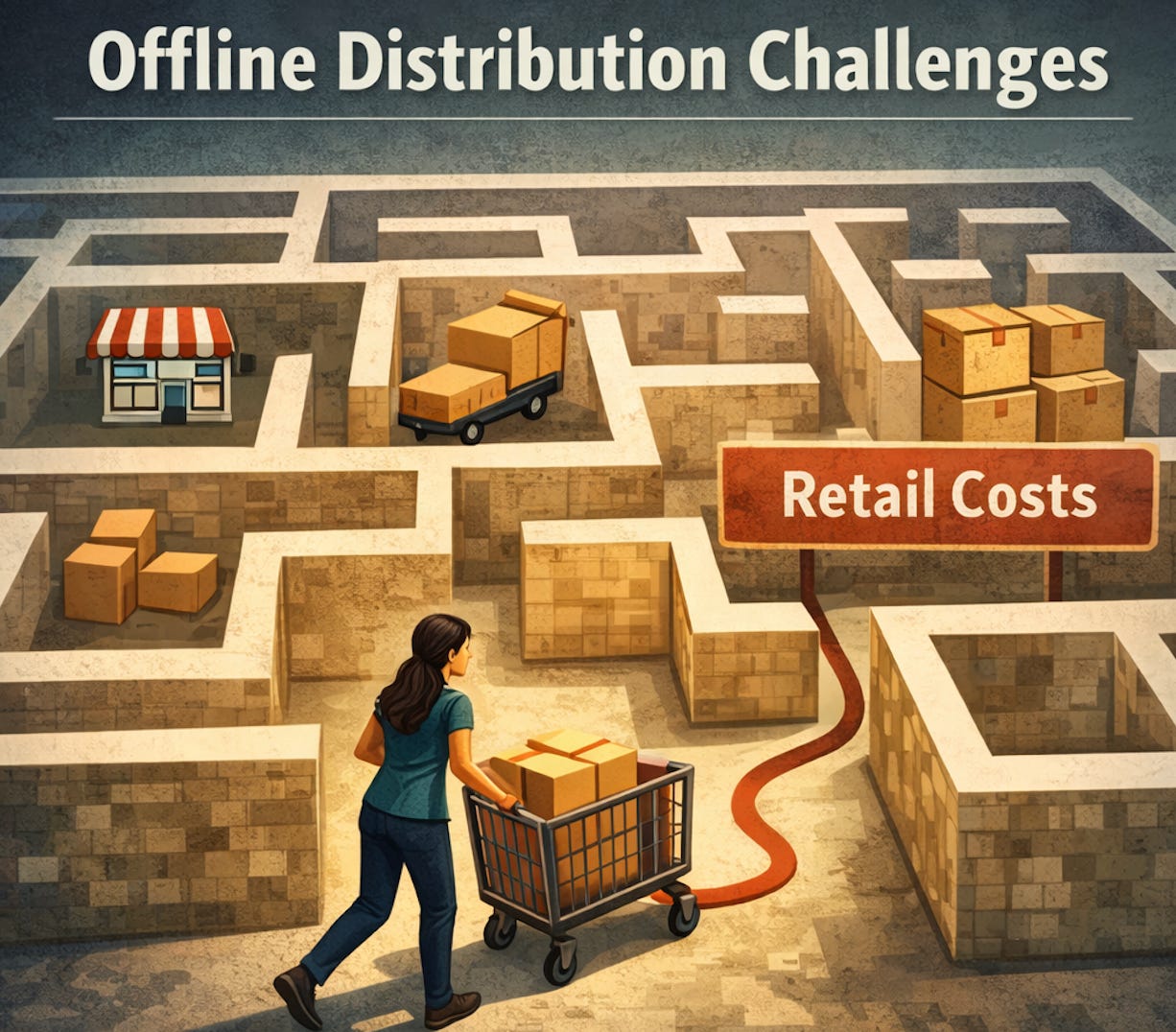
The problem. To reach mass-market consumers, most brands need an offline presence, including pharmacies, chemists, supermarket chains, and general stores. However, offline is capital- and logistics-intensive, as it involves distributors, sub-distributors, wholesalers, and rack-space deals. Each layer extracts margin; inventory sits in the system for months; retailers reject near-expiry SKUs. Short shelf-life SKUs (natural, preservative-light formulas) are particularly risky.
How the money disappears. Across a typical offline path, a large fraction of your MRP is consumed by distributor margins, retailer margins, trade promotions, and logistics. Industry practitioners estimate 30–40% of MRP can be eaten by channel economics for brands entering mass retail, meaning the brand’s take-home margin after channel costs can be thin. The real cost also includes returns, stock transfers and unsold expiries.
Working capital and the credit cycle. Offline often means 90–150-day receivables and returns windows. Money that could be used to buy raw materials or fund marketing is tied up as inventory sitting across dozens of storerooms. Smaller brands with thinner runways feel this acutely. The result: either scale slows, or the brand takes on unsustainable leverage.
Tactical steps:
Consignment/VMO trials: Collaborate with a distributor on a consignment basis for a pilot set of SKUs to mitigate upfront inventory risk.
Regional SKU rationalization: Produce SKUs in variants optimized for climate regions (less oily formulations where humidity is high).
Micro-fulfilment & pop-ups instead of company-owned stores: test omnichannel presence without store capital expenditure.
Shelf-life alignment: rework production cadence and packaging (e.g., smaller outer cartons or sachets) to avoid near-expiry rejections.

3. Rising CACs and the Deal-Hunter Trap
The problem. Advertising and creator spend skyrocketed as thousands of new D2C brands competed for the same attention across Instagram, YouTube, and ad networks. Platforms optimise for cheap conversions, which often produce “deal-hunters” — customers whose behaviour is dominated by promotions, not brand loyalty.
Market context. The total online beauty wallet is growing rapidly, but per-capita spend in India remains low by global standards. Reports indicate that India’s per-capita BPC spend is roughly US$14, far below that of China and the US, meaning the average LTV a brand can expect is structurally capped unless it raises AOV, improves retention, or captures premium customers.
As more players bid, CPMs and CPCs rise. To keep conversion volume, brands increase discounting and run frequent promotions. The effect: CAC remains high, but net revenue per acquired customer falls (discounts reduce AOV), and the majority of customers do not return.
PM thinking. Instead of optimising only for the cheapest first conversion, design acquisition funnels that prioritise propensity-to-repeat (creator content that shows multi-usage, subscription prompts at checkout, trial-to-refill hooks). Measure cost-per-retained-customer (e.g., CAC divided by the probability of retention at 90 days), not just cost-per-acquisition.
Tactical steps:
Experiment with creator cohorts on a longer attribution window (30–90 days) to properly value creators who drive higher retention vs those that drive cheap trial.
Increase first-order AOV via bundles or “trial + full-size” packages to ensure CAC is recoverable.
Build a simple predictive propensity model (early engagement indicators) to allocate higher acquisition spend to cohorts likely to repeat.
4. The Premium Perception Gap
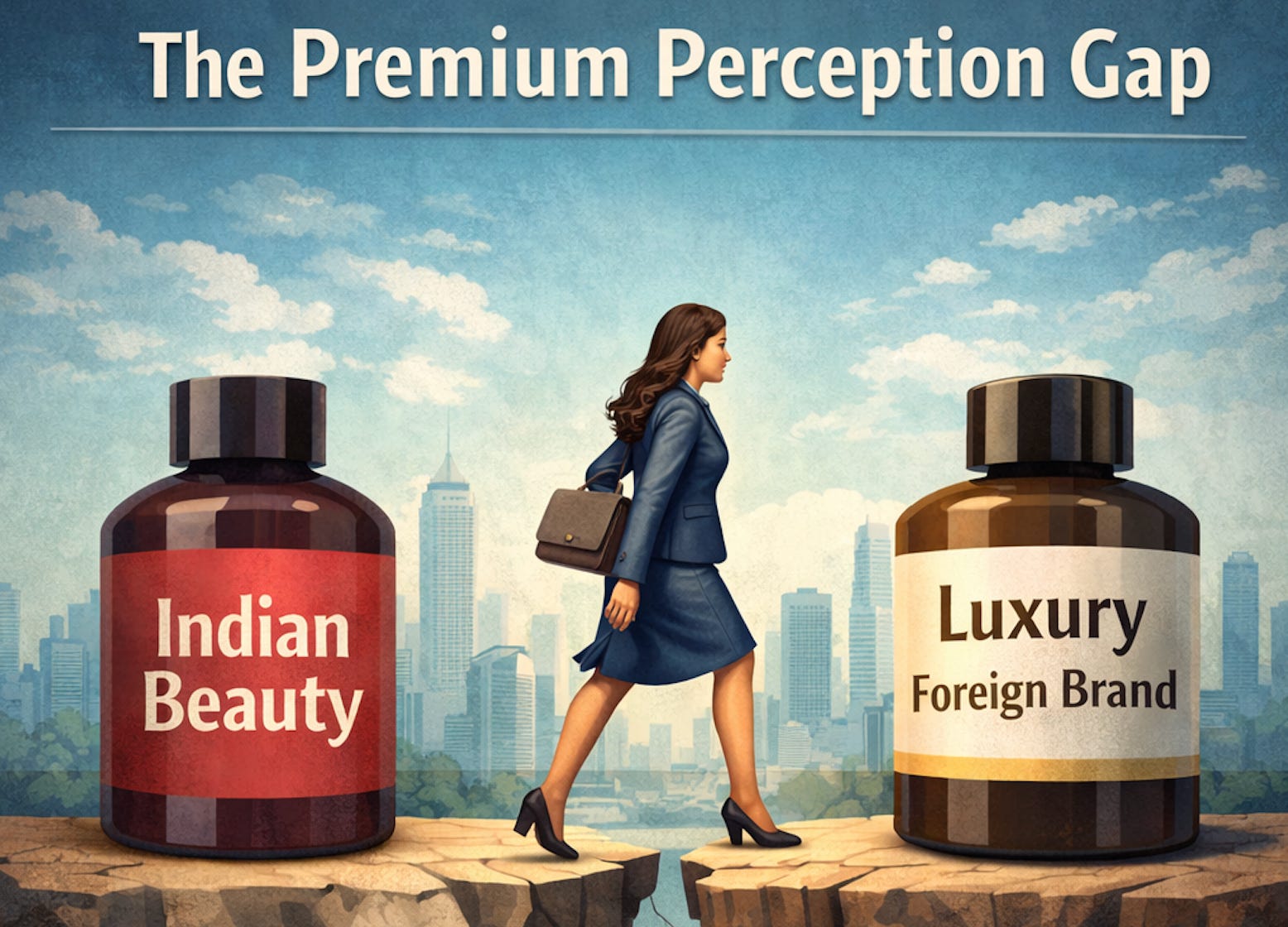
The problem: The premium segment, wealthy urban shoppers who spend heavily on beauty, disproportionately chooses foreign brands or Indian brands that signal premium in a way that matches global luxury expectations. This creates a structural challenge: Indian brands win mass volume but often fail to capture the small, fast-growing premium wallet.
Market segmentation:
Mass: Tier 2/3 and rural buyers, volume, price-sensitive, dominated by legacy FMCG.
Masstige: aspirational middle-class urban buyers, the sweet spot for many D2C brands.
Premium/luxury: small but fast-growing, tends to prefer foreign labels or Indian brands that have created a premium narrative and experience.
Why perception matters. Premium buyers not only spend more per transaction but also demonstrate higher loyalty and willingness to cross-sell. Losing these buyers to foreign brands means losing the cohort that can make AOV and LTV economics healthy.
How some brands solved it. A few Indian brands (e.g., Kamayurveda, Forest Essentials) successfully converted Indian heritage into a premium narrative with high-touch packaging, carefully curated retail experiences, and price points that convey exclusivity, then maintained margins accordingly. Minimalist’s product-led, science-first approach also demonstrated how clarity and manufacturing control can create investor and acquirer interest.
PM implications. If the goal is to capture premium wallets, the product roadmap must prioritise packaging, curated retail experiences and communications that signal global standards, and the business model must accept a slower SKU rollout cadence and higher starting ASPs (average selling prices).
