

Dear readers,
Thank you for being part of our growing community. Here’s what’s new this today,
Project Management Interview Preparation: Explain Dependency Types (FS, SS, FF, SF)
Note: This post is for our Paid Subscribers, If you haven’t subscribed yet,
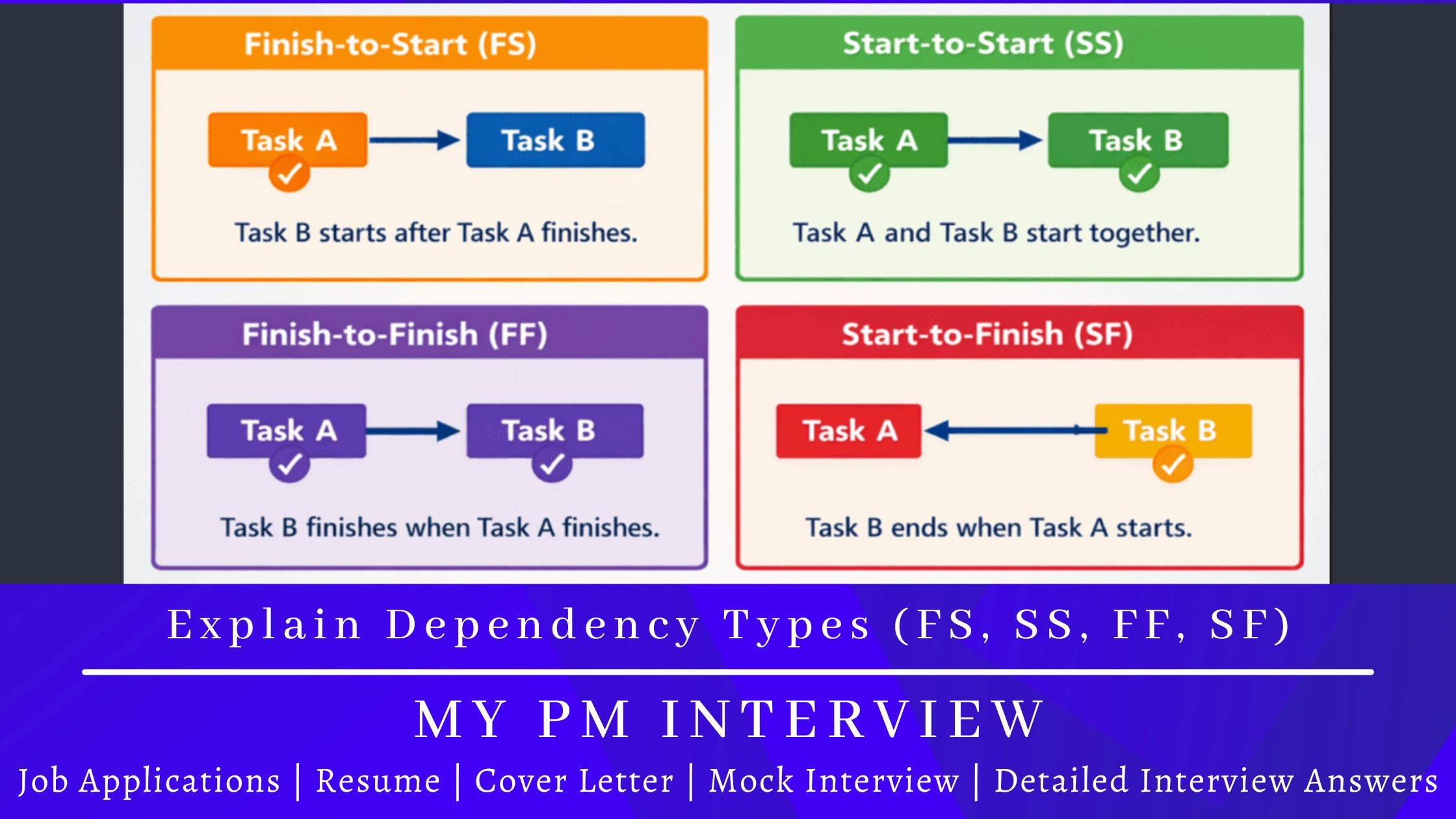
Table of Contents:
What Are Task Dependencies?
The Four Dependency Types Explained
Summary Comparison of the Four Dependency Types
Lead Time and Lag Time
Categories of Dependencies
How Dependencies Affect the Critical Path
Dependency Management Best Practices
Common Mistakes in Dependency Management
Dependencies in Agile Environments
Tools for Managing Dependencies
A Practical Example: Website Redesign Project
Every project is a web of interconnected tasks. Some tasks must happen one after another. Others can overlap or run in parallel. A few have unusual timing relationships where one task’s start governs another’s finish. Understanding these relationships, known as task dependencies, is fundamental to building accurate project schedules and managing timelines effectively.
The PMBOK Guide states that all tasks in a project should have at least one dependency, because if a task is part of a project, it must be related to other tasks in some way. Professional project management requires the ability to rapidly determine the schedule impact of changes, and dependencies are the mechanism that makes this possible.
In the Precedence Diagramming Method (PDM), which is the basis of most modern project scheduling software, there are exactly four types of logical relationships between tasks: Finish-to-Start (FS), Start-to-Start (SS), Finish-to-Finish (FF), and Start-to-Finish (SF). Each defines a specific timing relationship between a predecessor task and a successor task.
This article provides a comprehensive guide to these four dependency types. It explains what each one means, when to use it, provides real-world examples across industries, discusses lead and lag time, covers the broader categories of dependencies (mandatory, discretionary, internal, external), explores the impact on the critical path, and offers best practices for managing dependencies effectively.
What Are Task Dependencies?
A task dependency (also called a logical relationship) is a link between two project activities that defines the order in which they must be performed. In a project network, the predecessor is the task that logically comes first, and the successor is the task that follows. The dependency specifies how the start or finish of the predecessor controls the start or finish of the successor.
Dependencies are the building blocks of the project schedule network diagram. Without them, a schedule is simply a list of unrelated tasks with dates. With dependencies, the schedule becomes a dynamic model that can calculate the critical path, determine float, predict the impact of delays, and automatically adjust downstream dates when upstream tasks change.
The four dependency types arise from the combination of two possible connection points on each task (Start and Finish) between two tasks (predecessor and successor). This creates four logical combinations: Finish-to-Start, Start-to-Start, Finish-to-Finish, and Start-to-Finish.
PMBOK Context
The PMBOK Guide does not use the term “dependency” directly but refers to “logical relationships,” defined as a dependency between two activities or between an activity and a milestone. The Practice Standard for Scheduling recommends using Finish-to-Start relationships whenever possible and using SS, FF, or SF only when activities need to overlap.
The Four Dependency Types Explained
Each of the four dependency types defines a specific timing relationship between two tasks. The following sections explain each type in detail with definitions, visual descriptions, and multiple real-world examples.
