

Dear readers,
Thank you for being part of our growing community. Here’s what’s new this today,
Chief of Staff, Senior PM Interview Question -
How Chiefs of Staff and Senior PMs Build Culture, Read Teams, Manage Politics and Conflicts at Scale?
Note: This post is for our Paid Subscribers, If you haven’t subscribed yet,
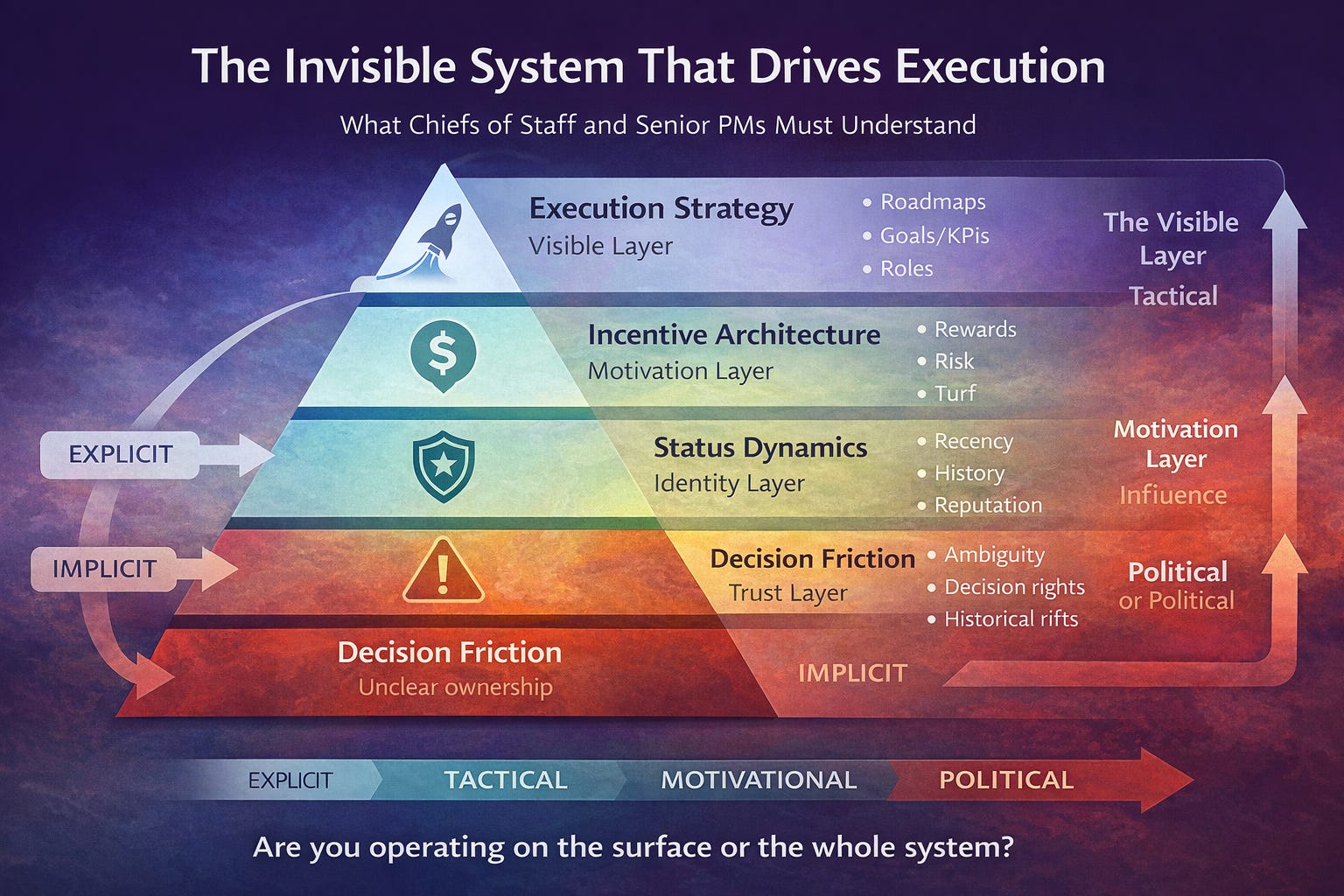
By the time you reach Chief of Staff or Senior PM roles, the work is no longer just about shipping.
It is about stabilizing the human system that makes shipping possible.
At junior levels, execution problems look tactical.
At senior levels, they are almost always structural.
Deadlines slip because trust is thin.
Roadmaps stall because incentives are misaligned.
Initiatives die because status is threatened.
Meetings drag because decision rights are unclear.
If you cannot see these forces, you will keep fixing symptoms.
Your job is not just delivery. Your job is also diagnosis.
What You’ll Learn,
Teams Are Political Systems
Influence Mapping in Practice
Culture Lives in Meetings
The Structure Beneath Conflict
Executive Psychological Safety
Chiefs of Staff as Stabilizers
Senior PMs as Translators
Managing Conflict Without Becoming Political
Organizational Maturity Signals
The Emotional Load of Senior Operators
Teams Are Political Systems
An org chart is fiction. It shows formal reporting lines, not the invisible networks that actually move work forward. At senior levels, the problem isn’t that people don’t work hard, it’s that influence, incentives, identity, and history create patterns of resistance and momentum that an org chart won’t reveal. Treating teams as neat functional units leads you to fix symptoms. Treating them as political systems lets you fix causes.
Below I expand the five invisible dimensions and show how to map them, read the room, and act.
The five dimensions
1. Formal authority
What it is: official roles, budgets, hiring power, and documented decision rights.
Why it matters: it defines accountability and the legal/policy levers people can pull.
Signals to watch for: who signs approvals, whose name is on the roadmap, who controls headcount.
2. Informal influence
What it is: who people actually listen to, trusted advisors, charismatic leaders, technical stars.
Why it matters: influence determines whose objections get weight even when they lack formal authority.
Signals to watch for: who people defer to in meetings, who gets copied on off-channel decisions, who’s asked for “advice” before a choice.
3. Incentives
What it is: the metrics, promotions, and recognition that shape behavior (revenue, uptime, adoption, cost control, PR wins).
Why it matters: incentives tell people what success looks like for them; misaligned incentives cause predictable conflict.
Signals to watch for: how performance reviews are framed, what gets celebrated in exec meetings, what targets leaders defend.
4. Identity (status & reputation)
What it is: what a leader’s reputation is built on, being “the product person,” “the founder who shipped X,” or “the reliable operator.”
Why it matters: status protects ego and career narratives; threats to identity prompt defensive behaviors that look like technical objections.
Signals to watch for: repeated references to past wins, defensiveness when prior projects are critiqued, language that frames change as criticising a person’s legacy.
5. History
What it is: prior conflicts, failures, and unresolved promises that still shape trust and expectations.
Why it matters: history gives events emotional weight; the same proposal will be read differently depending on past outcomes.
Signals to watch for: comments like “we tried that before,” selective memory about promises, recurring scapegoats or heroes.
How to map these dimensions
Pick an initiative (roadmap item, org change, major hire).
Create a 1-page table with five columns (authority, influence, incentives, identity, history).
List the 6-10 most relevant leaders/roles as rows.
For each person, add 1-2 bullets per column: who owns it, who they listen to, what they’re measured on, what defines their status, and any relevant past incidents.
Highlight likely points of resistance (e.g., “Loss of visibility for X”, “Incentive clash: revenue vs reliability”).
Do this privately first, then use it to guide alignment conversations.
What the map tells you
If influence ≠ authority: don’t expect formal approvals to be sufficient. Pre-align the influential advisor.
If incentives conflict: make tradeoffs explicit. Propose compensation/reward tweaks or a shared metric.
If identity is threatened: preserve dignity publicly, acknowledge past wins and reframe change as evolution.
If history poisons trust: surface the past explicitly (what happened, why it failed) and propose corrective guardrails (pilot, rollback plan, explicit success criteria).
Concrete moves: run 1:1s with invisible influencers, surface the influence map in a pre-read (not as accusation, as risk mitigation), codify decision rights in the meeting agenda, and ask “who loses if this succeeds?” before you present.
