

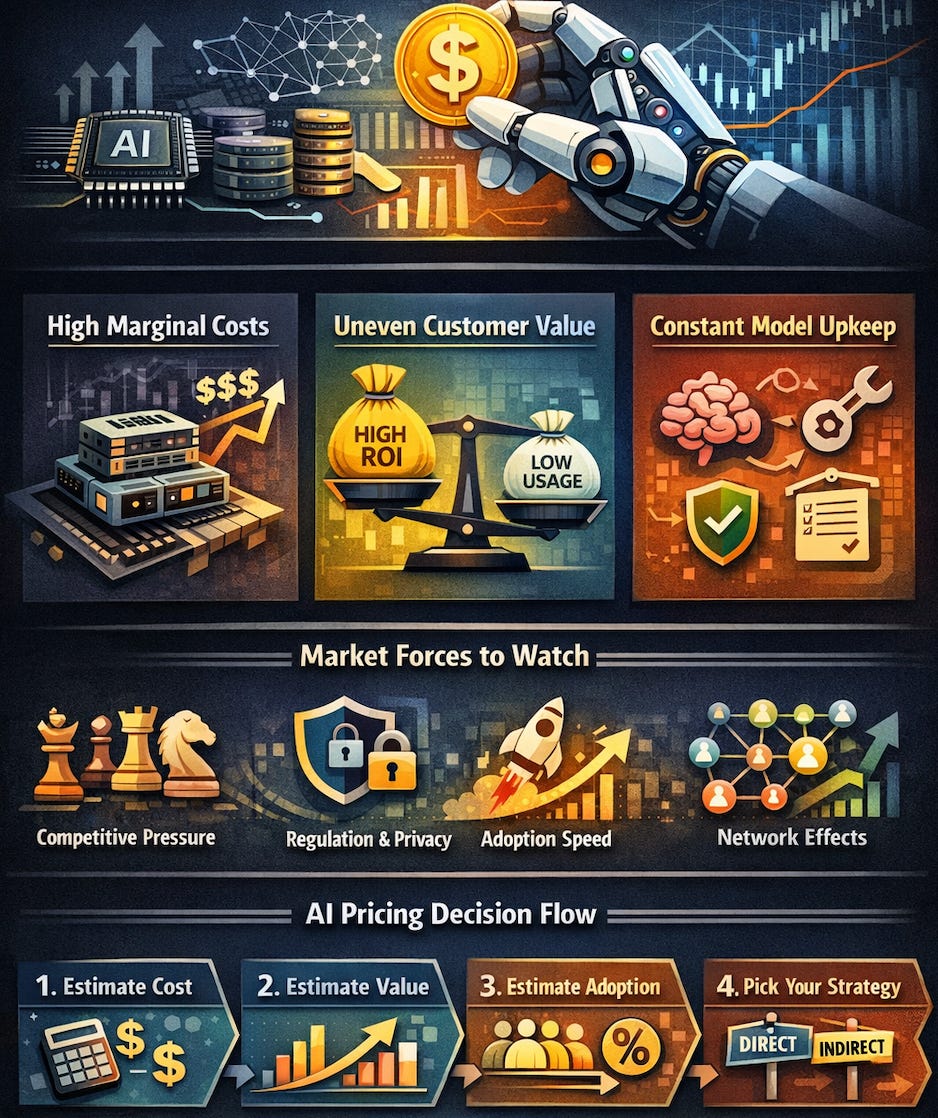
AI changes the pricing landscape in three structural ways. If you keep these in mind, your pricing decisions become less guesswork and more engineering.
Why AI reshapes pricing math?
Marginal costs are variable and often high. Inference compute, repeated fine-tuning, and large-scale storage mean your per-interaction cost can grow with usage, unlike mostly fixed-cost software features.
Value is outcome-driven and uneven. Some customers capture enormous ROI from a model (e.g., automating workflows) while others barely use it. That makes one-size-fits-all pricing risky.
Product evolution and maintenance are continuous. Models need retraining, drift monitoring, human-in-the-loop fixes and compliance work, ongoing items that must be funded somehow.
Market forces to watch
Competition & expectations: If competitors give similar AI features away, charging for them may severely limit adoption.
Adoption speed & education cost: Complex AI value often requires demos, onboarding, and trust, if that’s expensive, you may want to incentivize trial.
Regulation & privacy: Regulatory constraints (data residency, consent) can affect who can use the feature and at what cost.
Network effects & flywheels: Some AI features become more valuable as more users contribute data or feedback; pricing should encourage, not block, that loop.
Simple decision flow
Use this flow every time you evaluate an AI feature:
Estimate cost — incremental compute + storage + human ops per active user / interaction.
Estimate value — what measurable customer benefit does the feature create? Time saved, revenue uplift, error reduction? Translate to $ where possible.
Estimate adoption — who will use this and at what percent of your base? Are they core buyers or niche power users?
Pick a go-to-market — choose direct monetization if cost is high and value is clear; choose indirect if the feature mainly drives engagement/retention or is table-stakes.
Short rule: if value reliably > cost and the benefit is clear to the buyer, you can justify direct pricing. If the feature mainly improves retention/engagement or is a competitive parity feature, prefer indirect strategies to grow adoption.
Financial Model: Direct vs Indirect
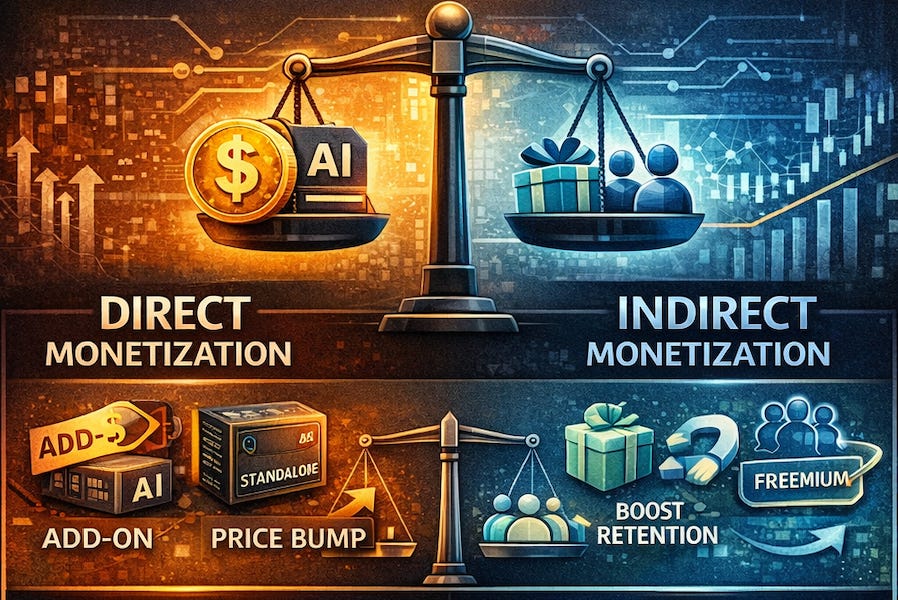
Direct monetization: You charge customers specifically for the AI capability (add-on, standalone product, or price bump).
Indirect monetization: You don’t charge separately for the AI capability, it’s included for free, used to drive adoption, or offered in a freemium tier.
Pros & Cons :
Direct:
Pros: Captures revenue to offset high compute/ops; signals premium value; easier to measure incremental MRR
Cons: Risks slower adoption; needs clear ROI to avoid churn
Indirect:
Pros: Faster adoption; boosts retention and usage of primary product; lower friction for users
Cons: Harder to recover costs directly; risk of subsidizing heavy users; may cannibalize upgrades
When to pick Direct
Pick a direct model if most of the following are true:
The feature adds measurable, near-term ROI for users (time saved, revenue uplift, clear KPI improvements).
Per-use costs (compute, labeling, human review) are material and will scale with adoption.
The target buyer is willing to pay for productivity/efficiency gains (enterprise buyers, power users).
Your sales motion is suited to value-led selling (AEs can show ROI in demos or pilots).
Example: An LLM that generates legal contracts that save lawyers three hours per contract, enterprise buyers are likely to pay because the ROI is tangible.
When to pick Indirect
Pick indirect if most of the following are true:
The AI feature increases retention, engagement or conversion for your main product but is not a stand-alone revenue generator.
Competitors offer similar AI for free and you risk losing parity.
You need rapid adoption to improve model quality (data network effects) or to create a content base.
Customer education or trial friction is high, removing price can accelerate usage.
Example: Auto-generated alt text on a social platform; it increases accessibility and engagement, but charging would reduce use and harm the network effect.
Packaging Strategies
Packaging determines how customers encounter and buy your AI, it shapes conversion paths, sales motions, billing complexity, and customer expectations. Get packaging wrong and you either leave money on the table or kill adoption.
