

Step 1: Ask Clarifying Questions
Q: When the colleague says “large quantities,” what scale are we talking about -- five units, fifty units, or hundreds?
I will assume we are talking about orders of 10 to 100 units of a single SKU, which is the sweet spot for small businesses and resellers rather than individual consumers. This matters because 10 units requires a different UX than 500 units, which would need a procurement-style flow with quotes and invoices.
Q: Who are these bulk buyers -- individual consumers buying gifts, small businesses reselling, or corporate procurement teams?
I will assume the primary segment is small-business resellers: phone repair shops, second-hand retailers, and gift buyers purchasing 10 to 50 units. This shapes whether we need a B2B invoicing flow or a simplified quantity-picker.
Q: Do sellers on Back Market currently have the inventory to fulfil bulk orders, or is inventory thin per seller?
I will assume sellers typically list 5 to 30 units of a given condition-grade SKU. So bulk checkout must handle split-seller fulfilment when a single seller cannot cover the full quantity.
Q: Is the goal primarily revenue growth, seller satisfaction, or buyer retention -- or all three?
I will treat GMV growth as the primary goal, with seller NPS as a guardrail. Bulk orders drive significantly higher cart values, so even a small conversion lift compounds quickly.
Q: Are there regulatory or warranty implications for selling refurbished devices in bulk in Europe -- for example, does the 12-month Back Market guarantee apply per unit?
I will assume the existing Back Market guarantee applies per unit regardless of quantity, and that we are not entering B2B contract territory (no custom SLAs). This keeps the legal surface manageable for V1.
Q: What does the current experience look like when someone tries to buy more than one unit -- do they add to cart multiple times, or is there already a quantity field?
I will assume there is a basic quantity field on the product page but no optimised bulk checkout flow: no volume pricing, no consolidated shipping, no bulk invoice, and no saved bulk lists. The drop-off data the colleague referenced happens between quantity selection and payment.
Q: What markets should we prioritise -- France (Back Market’s home), Germany, the US, or global?
I will focus on France and Germany first, since Back Market has the strongest seller density there and the reseller/repair-shop market is well-developed in both. The US can follow in Phase 2.
These questions accomplish two things. First, they narrow an ambiguous word (”bulk”) into a precise scope that determines the entire build. A 10-unit flow and a 500-unit procurement portal are fundamentally different products. Second, they surface the constraint that inventory is distributed across many sellers, which means the hardest engineering problem is not the UI -- it is split-order logic. A candidate who skips clarification here will design a beautiful checkout screen that cannot actually fulfil the order.
Step 2: Describe the Product
Market Context
Back Market was founded in 2014 in Paris and is today the world’s largest dedicated marketplace for certified refurbished electronics. As of 2024 the platform operates in 17 countries, lists over 6 million refurbished products, and has served more than 12 million customers globally. Its GMV crossed 1 billion euros in 2022. Back Market does not hold inventory -- it is a pure marketplace connecting buyers with professional refurbishers and resellers, taking a commission of roughly 10 to 12 percent per transaction. The platform’s core value proposition is trust: every seller is vetted, every device is certified, and every purchase comes with a minimum 12-month Back Market guarantee on top of the seller’s own warranty. The refurbished electronics market in Europe is growing at roughly 9 percent CAGR and is projected to reach 50 billion euros by 2027, driven by sustainability consciousness, rising new-device prices, and tightening corporate ESG mandates.
The Opportunity
The bulk purchase signal the colleague observed is demand Back Market has not explicitly served. Repair shops need batches of iPhone screens or Samsung motherboards. Corporate IT teams refresh 20 to 50 laptops per cycle. Gift-buying coordinators order 10 to 20 tablets for employee onboarding. These buyers currently work around the standard single-unit checkout: they open multiple browser tabs, place separate orders, pay shipping five times, and receive five invoices. This friction causes abandonment and also means Back Market is losing the full order value to Amazon Business or Swappie, where some bulk purchasing is easier. A back-of-the-napkin estimate: if 3 percent of Back Market’s monthly active buyers (roughly 400,000) have attempted a multi-unit order and 60 percent abandon due to friction, that is approximately 7,200 lost transactions per month. At an average refurbished smartphone price of 280 euros and an order of 10 units, each recovered transaction is worth 2,800 euros in GMV -- a potential 20 million euros per month in recoverable GMV at scale.
Competitive Landscape
Amazon Business offers quantity pricing tiers, consolidated invoicing, and GST-ready receipts but sells mostly new devices and has no refurbishment quality guarantee. Swappie (Finland-based) focuses on iPhones, offers quantity discounts for orders above 5 units, and targets consumers rather than businesses. Back Market’s advantage is its multi-brand, multi-category certified refurbished inventory -- no competitor matches its breadth. The risk is that without a dedicated bulk flow, Back Market cedes the B2B segment permanently to Amazon Business, which is aggressively expanding its refurbished-electronics catalogue. Building bulk checkout now, while Back Market’s trust brand is strong, creates a durable moat.
Step 3: Define the Goal
Product Goal: Increase GMV from multi-unit orders (2 or more units of the same SKU in a single checkout session) by 40 percent within 12 months of launch, measured as a monthly rolling average in France and Germany.
This goal connects directly to Back Market’s core business model: the company earns commission on every transaction, so GMV is the closest proxy to revenue. I chose multi-unit GMV rather than overall GMV because it isolates the impact of this specific feature set and prevents the metric from being polluted by general market growth. A 40 percent lift is ambitious but grounded -- it assumes we recover roughly 30 percent of the estimated abandoned bulk-intent sessions and modestly grow average order size through volume pricing incentives. The 12-month window gives us time to ship, iterate, and accumulate enough data for statistical confidence. Seller commission per transaction and buyer NPS serve as guardrails to ensure we are not growing GMV by subsidising bulk orders in ways that harm the unit economics.
Step 4: User Segmentation
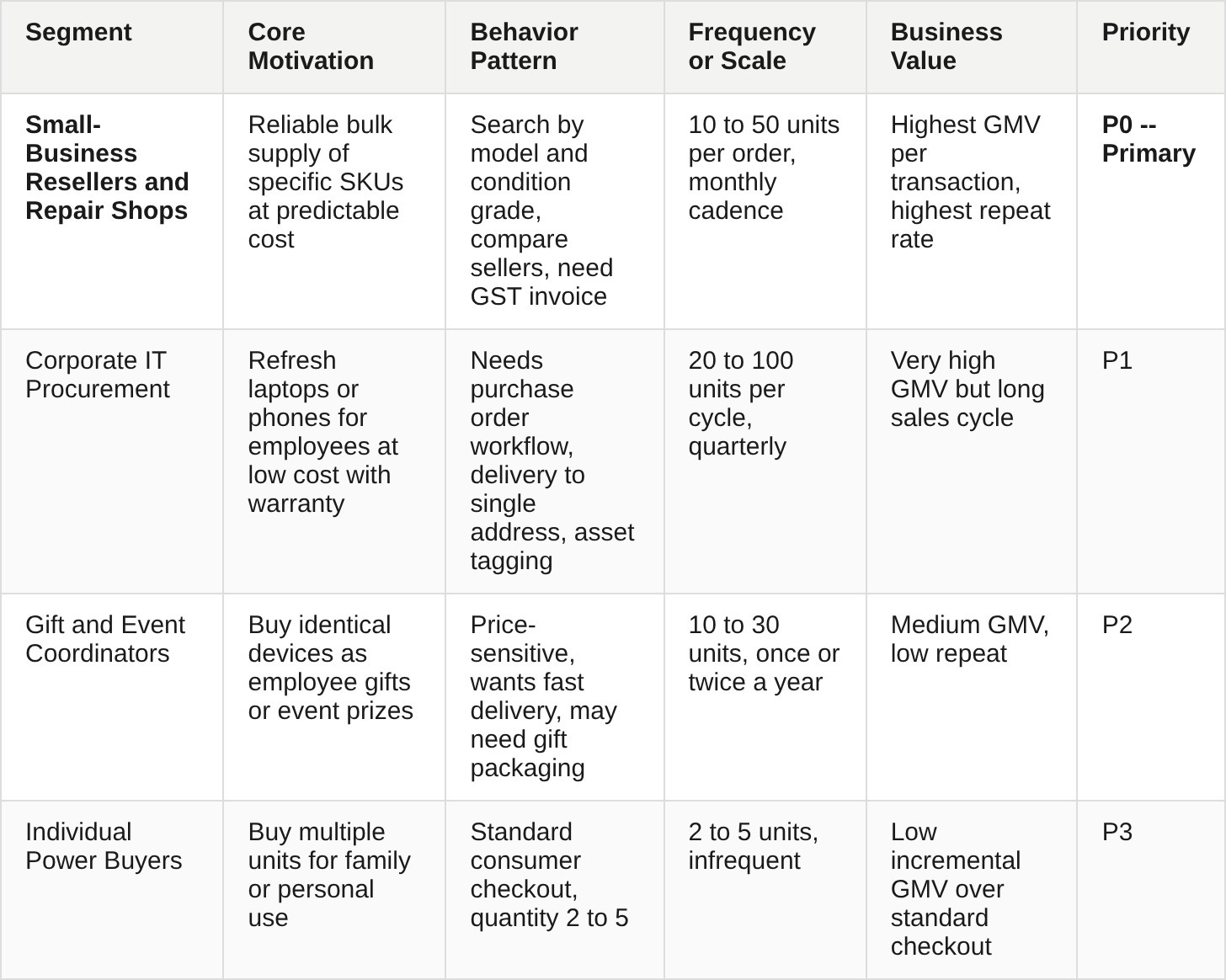
I am focusing on small-business resellers and repair shops as the primary segment. They have the highest transaction frequency, the clearest unmet need (no bulk invoice, no consolidated shipping), and the lowest cost to acquire because Back Market can reach them through existing seller communities and trade publications. Priya Subramaniam, 34, runs a mobile phone repair shop in Bengaluru’s Koramangala neighbourhood. She sources refurbished iPhone 13 screens in batches of 20 to 30 units every six weeks. She currently places five separate orders on Back Market, pays five separate shipping charges averaging 8 euros each (roughly Rs 720 each), receives five invoices she has to manually reconcile, and still is not sure all units will arrive with the same condition grade. She has heard of Back Market’s quality guarantee but does not trust that it will hold consistently across a fragmented multi-order purchase. If Back Market gave her a single bulk checkout, consolidated shipping, one invoice, and a guarantee that all units share the same grade, she would switch her entire sourcing to the platform within a month.
Step 5: Map the Current Experience and Diagnose Pain Points
What Already Exists
A quantity field on the product detail page allowing up to the seller’s listed stock
Standard single-seller checkout with one shipping quote per order
Back Market guarantee applied per order confirmation email
A saved-items wishlist (not bulk-oriented)
Seller ratings and condition-grade labels (Excellent, Good, Fair)
