

Dear readers,
Thank you for being part of our growing community. Here’s what’s new this today,
Product Management Interview Question:
Q: How would you improve Instagram stories?
Note: This post is for our Paid Subscribers, If you haven’t subscribed yet,
Before jumping into solutions, I want to make sure I understand the scope and constraints of this question clearly.
Step 1: Ask Clarifying Questions
Q: When we say “improve Instagram Stories,” which specific surface are we focusing on? The viewing experience, the creation experience, the ranking and ordering of stories, or the interaction layer?
Let us take a broad view of the consumer-facing Stories experience as a whole, since viewing, creation, and interaction are deeply connected. We will prioritize improvements that increase meaningful engagement -- the quality of interaction between users -- over improvements that simply increase passive viewing time.
Q: What is the primary goal: increasing daily active users on Stories, increasing creation rate, increasing interaction rate, or improving retention?
Let us optimize for engagement quality and retention together. A Stories improvement that increases passive viewing but reduces meaningful interaction (replies, reactions, prompt responses) is not a net win. The goal is increasing Meaningful Story Interactions per User per Week.
Q: Are we thinking globally, or focusing on a specific geography?
Global, but we will note where specific user behaviors -- such as the dominance of Stories for close-friend communication in Latin America and Southeast Asia -- inform design decisions.
Q: Should I account for what Instagram already ships in Stories, or treat this as a greenfield problem?
Build on what exists. Proposing features already live -- polls, Q&A stickers, Close Friends, Highlights -- is disqualifying at the senior level. Map current state first, then identify gaps.
Q: Are we designing for all Instagram users, or a specific account type: personal, creator, or business?
Primary focus on personal and social users, since Stories’ original differentiation was authentic peer-to-peer sharing. Creator and business use cases are secondary -- they have Reels and branded content tools as their primary canvas.
Q: Should I consider the tension between organic Stories and Instagram’s growing ad inventory in Stories?
Yes. That tension is real and any serious improvement strategy must address it. Story ads account for a meaningful share of Instagram’s ad revenue, and improvements that reduce ad impressions without a revenue offset will not ship.
Q: Are we constrained to mobile only, or should we also think about Stories on desktop and the web app?
Mobile-first. The overwhelming majority of Stories creation and consumption happens on mobile, and the interaction model (tap-to-advance, swipe-to-reply) is native to touch.
Q: Should we focus on improving Stories in isolation, or consider how it interacts with Reels, Feed, and DMs?
Consider the interaction surface, but do not optimize for it at the expense of Stories’ identity. The strategic risk is that improvements push Stories to look like Reels. The goal is differentiation, not convergence.
These clarifying questions establish critical boundaries. The “already shipped” question prevents proposing polls or Q&A stickers (launched in 2017 and 2018 respectively). The ads question signals commercial awareness. And the differentiation question -- Stories vs. Reels -- is the most strategically important framing choice in this answer: it defines whether you are optimizing for a content feed or a social connection layer.
Step 2: Describe the Product
Instagram is Meta’s photo and video sharing platform, launched in 2010 and acquired by Meta in 2012. It is one of the most-used social platforms in the world, with over 2 billion monthly active users as of 2025.
Core Product Surfaces
Feed: Algorithmic photo and video posts from followed accounts and recommended content
Stories: Ephemeral photo and video clips lasting 24 hours, launched in 2016; over 500 million accounts use Stories daily
Reels: Short-form video feed, Instagram’s answer to TikTok; primary entertainment and discovery surface since 2020
Direct Messages (DMs): Private messaging, including story reactions and replies that land as DMs
Explore: Discovery surface for new accounts, trending content, and interest-based recommendations
Close Friends: A curated list feature allowing users to share Stories with a smaller, trusted inner circle
Key Metrics
2 billion monthly active users globally as of 2025
500 million accounts engaging with Stories daily
Stories launched in 2016, directly inspired by Snapchat Stories; it surpassed Snapchat’s daily active users within 18 months of launch
Instagram is the second most downloaded app globally; dominant in Brazil, India, Indonesia, and the United States
Stories ad inventory is one of Meta’s most monetized placements, with ads appearing every 3 to 5 organic stories on average
Mission and Competitive Context
Instagram’s mission is “to bring you closer to the people and things you love.” Its primary competitors for the Stories-adjacent use case include Snapchat (ephemeral sharing), TikTok (short-form social video), and BeReal (authentic, unfiltered sharing). The core tension is that Instagram has evolved from a close-friend sharing tool into a media consumption platform. Stories is one of the last surfaces that retains the original friend-connection character, but that character is eroding as creator content and ads increasingly dominate the Stories tray.
Step 3: Define the Goal
Product Goal: Improve the Instagram Stories experience for personal users so that they share more authentically, interact more meaningfully with close friends, and return to Stories as a genuine social connection layer rather than a passive content feed. The measurable outcome is an increase in Meaningful Story Interactions per User per Week and an improvement in 30-day Stories retention rate among high-frequency personal users.
This goal aligns with Instagram’s mission of bringing users closer to the people they love and addresses the platform’s most important strategic challenge: as Reels captures entertainment time, Stories must own the authentic social sharing space or risk losing its unique reason to exist.
It also has a direct business case: users who interact meaningfully with Stories through replies, reactions, and prompt responses generate stronger social graph signals, which improves ad targeting precision and reduces the perceived intrusiveness of Story ads by surrounding them with higher-quality organic content.
Step 4: User Segmentation
Instagram Stories serves a vast and heterogeneous user base. The experience problem looks very different depending on who you are designing for.
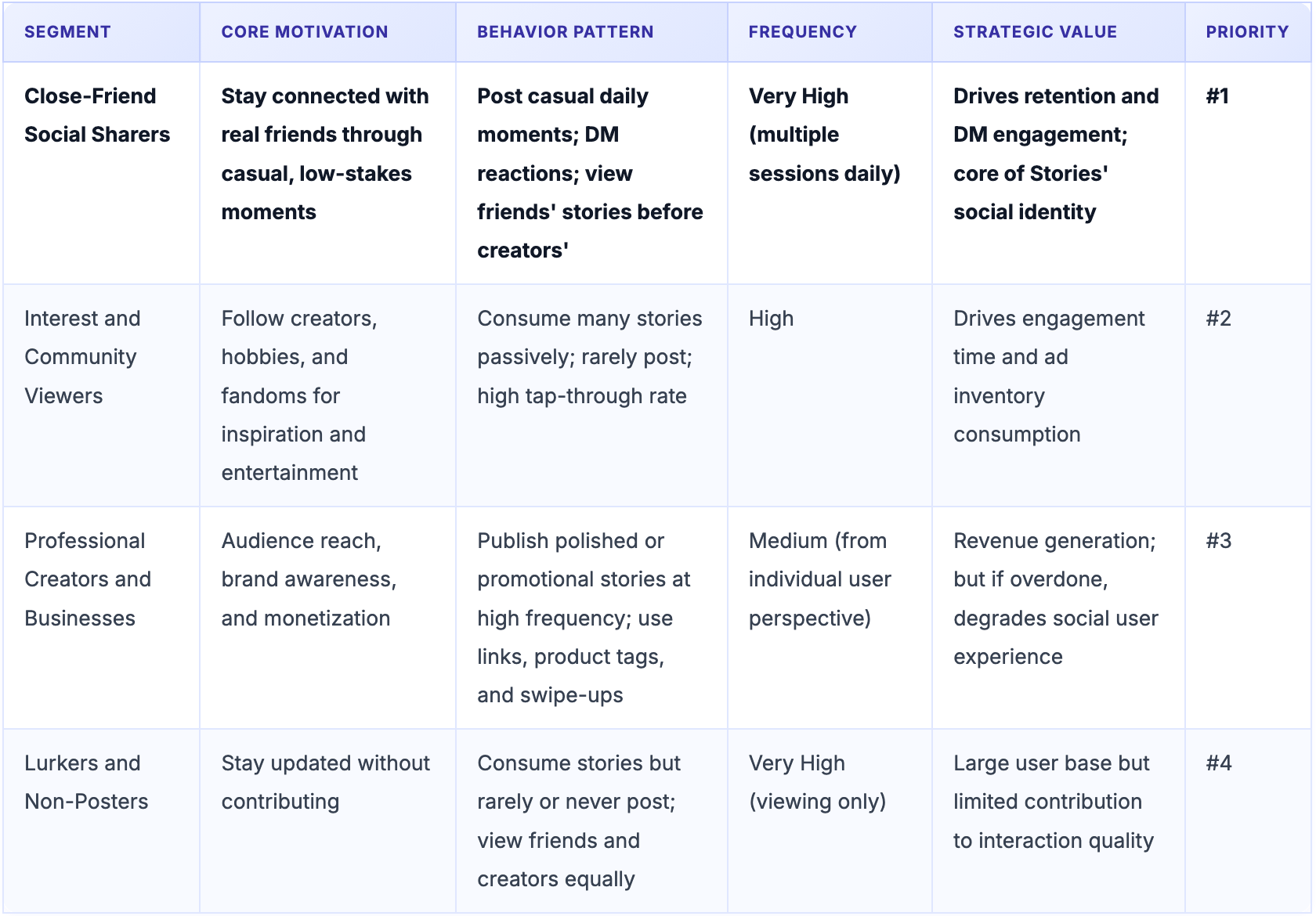
Prioritized segment: Close-Friend Social Sharers.
The reason is strategic, not just behavioral. This segment represents what Stories was originally designed for and what makes it irreplaceable:
They post the most frequently among personal users, giving the recommendation model the richest signal to work with
Their interaction pattern (reply DMs, reactions, prompt responses) is the most valuable signal for Instagram’s social graph
They are most at risk of being displaced by BeReal and Snapchat, which offer cleaner, lower-friction authentic sharing without creator and ad clutter
When this segment churns from Stories, the social layer of Instagram degrades, which accelerates the platform’s drift toward a pure entertainment feed -- a direction where TikTok has a structural advantage
Representative Persona: Maya, 24, a marketing coordinator in Mumbai. Uses Stories 15 to 20 times per day. Shares casual life moments: her coffee, her commute, a funny moment at work. Wants lightweight interactions with close friends who reply and react. Feels Stories has become cluttered with ads, influencer reposts, and promotional content that has nothing to do with her actual social circle. Often taps through stories quickly without meaningful interaction. Has started using BeReal occasionally because it feels more honest.
Secondary segment: Interest and Community Viewers, because improving content relevance for them improves the quality of the Stories tray for all users and they represent the bulk of Story ad impression volume.
Step 5: Map the Current Product and Diagnose Pain Points
Before proposing improvements, here is what Instagram Stories already does well as of 2025, and where its structural gaps lie.
What the System Already Does
Ephemeral posting: 24-hour content lifecycle reduces perfection pressure compared to permanent feed posts
Interactive stickers: Polls, Q&A, quizzes, countdowns, sliders, and link stickers enable structured interaction without DMs
Close Friends list: Allows users to share selectively with a trusted inner circle; green ring distinguishes Close Friends stories
Highlights: Permanent collections of past stories organized by theme; extends the life of story content beyond 24 hours
Story ranking: Instagram orders the stories tray algorithmically based on predicted interaction likelihood, not strict chronological order
Add Yours sticker: Allows users to participate in community trends across accounts
Reaction system: Eight emoji reactions plus free-text replies, all landing in DMs
The Central Gap
Instagram Stories has evolved from an active social sharing surface into a passive content carousel. The original premise was that friends would share unfiltered moments and react to each other in real time. The current reality is that the Stories tray is dominated by high-volume creators, business promotions, and ad placements, with authentic close-friend content buried or absent entirely. The system is optimized for content volume and ad inventory, not social connection quality. The result: users like Maya tap through Stories mechanically, without the sense of genuine connection that once made the format compelling.
Pain Point 1: Story Fatigue and Passive Consumption
Users tap through stories at high speed with minimal emotional engagement.
The average story is viewed for less than 2 seconds before the user taps forward
High-volume posters (creators, businesses) dominate tray position through posting frequency, pushing close-friend content down
When there is no reason to pause -- no interactive element, no personal connection -- tapping through becomes a reflex, not a social act
Users describe the experience as “watching TV with strangers” rather than catching up with friends
Pain Point 2: Low Relevance in Story Ordering
The ranking algorithm optimizes for predicted interaction likelihood based on historical engagement, but it systematically surfaces high-volume posters over high-value contacts.
A creator who posts 10 stories per day will appear at the front of the tray more consistently than a close friend who posts once a week
Users with large followings (500+ accounts) report never seeing close friends’ stories unless they specifically seek them out
The algorithm treats creator content and friend content as equivalent inputs, when they serve fundamentally different user needs
Instagram’s own Close Friends feature is poster-controlled; it does not help the viewer who wants to prioritize friends they care about but who have not curated their own list
Pain Point 3: Creation Friction and Performativity Pressure
Users hesitate to post because Stories has come to feel performative, even though it was originally designed to be casual.
The same canvas used by professional influencers and brands creates an implicit standard that casual content feels inadequate against
Users report leaving Stories drafts incomplete because “it is not interesting enough”
BeReal’s growth is directly attributable to this: its forced two-minute window and front-plus-back camera explicitly remove the pressure to stage content
When the creation barrier rises, fewer personal users post, which means fewer close-friend stories in the tray, which means the viewing experience degrades further for all users
Pain Point 4: Weak Interaction Depth
The current interaction model is shallow: eight emoji reactions and free-text replies, all routed through DMs where they get buried in message threads.
An emoji reaction requires no thought and conveys little meaning; it does not start a conversation
A reply DM gets mixed into the general inbox with promotional messages and other notifications, reducing its social salience
There is no mechanism for a group of friends to interact collectively around a single story -- each reply is a private bilateral thread
The result is that interactions feel transactional rather than social; a heart emoji is acknowledgment, not connection
Pain Points 1 and 3 are causally linked: passive consumption and creation friction reinforce each other. When fewer friends post, there is less worth watching. When there is less worth watching, fewer people bother posting. This is a classic engagement death spiral, and it is the core structural risk facing Stories as a format.
Step 6: Propose Solutions
Solutions are organized across three layers: content relevance (what appears in the tray and how), creation and participation (what lowers the barrier to posting), and interaction depth (what makes engagement more meaningful). Each layer addresses specific pain points from the diagnosis above.
