

Dear readers,
Thank you for being part of our growing community. Here’s what’s new this today,
Product Management Interview Question:
Q: How would you improve the Starbucks app?
Note: This post is for our Paid Subscribers, If you haven’t subscribed yet,
Content:
Step 1: Ask Clarifying Questions
Step 2: Describe the Product
Step 3: Define the Goal
Step 4: User Segmentation
Step 5: Map the Current Product and Diagnose Pain Points
Step 6: Propose Solutions
Step 7: How the Improved Starbucks App Experience Works for Vikram
Step 8: Solution Prioritisation
Step 9: Success Metrics
Step 10: GTM Strategy
Before jumping into solutions, I want to make sure I understand the scope and constraints of this question clearly.
Step 1: Ask Clarifying Questions
Q: When we say “improve the Starbucks app,” are we focused on the US market, or should I consider global markets too?
I will focus on the US market, where Starbucks has its deepest app adoption, its full Rewards programme, and the most mature mobile ordering infrastructure. International markets have different payment rails and loyalty structures, so scoping to the US keeps the analysis actionable.
Q: Are we optimising for a specific business objective: revenue growth, retention, new user acquisition, or operational efficiency?
I will treat retention and engagement of existing Rewards members as the primary goal. With 57% of US revenue coming from Rewards members, keeping that cohort happy and growing their spend is more valuable per-dollar than acquiring new users who may churn.
Q: Is there a constraint on what parts of the app we can touch? For example, are payments or the Rewards points engine off-limits because they are governed by separate teams or legal constraints?
I will assume no hard constraints, but I will note where a proposal would require cross-functional alignment with the store operations or loyalty finance teams, since those have longer approval cycles.
Q: What is the primary platform: iOS, Android, or both equally?
Both platforms matter, but iOS skews slightly higher among urban Rewards members. I will treat them as equivalent and call out any platform-specific nuance only where it materially changes the recommendation.
Q: Do we have access to in-store POS data and barista capacity signals that the app could consume in real time?
I will assume yes, because Starbucks already runs a proprietary POS system (Oracle Simphony) and has centralised visibility into queue depth at each store. Any real-time wait-time feature would depend on this data pipeline being accessible to the app layer.
Q: Is the definition of success purely digital (app engagement, DAU, push notification CTR) or does it extend to physical outcomes like in-store wait time and barista throughput?
I will define success as a hybrid metric that spans the digital-to-physical handoff. The most important moment in the Starbucks app journey is when the customer actually picks up their drink. A great app experience that leads to a frustrating pickup destroys the value we created digitally.
After these clarifications, I am narrowing the focus to: improving the mobile order and pickup experience for existing daily-habit Rewards members in the US, measured by a post-order satisfaction rate that spans both the digital ordering flow and the physical pickup.
Step 2: Describe the Product
The Starbucks app is one of the most commercially successful retail mobile apps in the world. It has more than 35 million downloads and 31 million active Rewards members in the US. Rewards members account for 57% of total US revenue, and the average Rewards member spends roughly three times more than a non-member. Mobile Order and Pay alone accounts for approximately 30% of all US Starbucks transactions, which means the app is not a supplementary channel: it is a primary revenue engine.
Core Surfaces
Mobile Order and Pay: Browse the full menu, customise a drink with 100-plus modifiers, select a pickup store, pay, and receive an estimated ready time.
Starbucks Rewards: Earn Stars on every purchase (2 Stars per dollar at the highest tier), redeem Stars for food and drink, unlock personalised bonus challenges, and receive a free birthday reward.
Menu and Customisation: Full digital menu with calories, allergens, and an open-ended modifier system that supports 800-plus drink combinations.
Store Finder and Wait Times: GPS-based nearby store list with “estimated wait” displayed (though frequently inaccurate).
Gift Cards: Purchase, send, and reload digital gift cards; consolidate multiple cards into one balance.
Pay in Store: Scan a barcode at the counter to pay with Starbucks balance or linked card.
Starbucks Delivers: Integrated Uber Eats ordering for home or office delivery.
Challenges and Games: Time-limited bonus Star promotions (Double Star Days, seasonal challenges) to drive visit frequency.
Key Metrics
31 million active US Rewards members
57% of US revenue from Rewards members
Rewards members spend 3x vs. non-members on average
Mobile order wait time complaints are the number-one topic in negative App Store reviews
Roughly 30% of US transactions initiated via mobile order
Mission and Competitive Context
Starbucks’ mission is “to inspire and nurture the human spirit — one person, one cup, one neighbourhood at a time.” The app is meant to be a digital extension of the “third place” philosophy: a place between home and work where customers feel recognised and welcomed. In practice, the app excels at the transactional layer (order, pay, earn) but underdelivers on the human layer (recognition, connection, community).
Competitively, the Dunkin app (22 million-plus members) offers a simpler, faster UX at the cost of personalisation. McDonald’s MyMcDonald’s Rewards uses aggressive value deals to win price-sensitive customers. Dutch Bros is growing rapidly with a Gen Z-focused, social-first app experience. The risk for Starbucks is not that competitors copy its loyalty programme: it is that the app’s friction (congestion, confusion, complexity) gradually erodes the premium-experience justification for the higher price point.
Step 3: Define the Goal
North Star Metric: Mobile Order Satisfaction Rate — the percentage of mobile orders where the customer rates the pickup experience 4 or 5 stars in the post-order survey. This metric sits at the intersection of the digital promise (order ahead, skip the queue) and the physical delivery (drink ready on time, correct, at the right temperature). Improving this rate is the most direct proxy for whether the app is fulfilling its core value proposition.
The business case is straightforward. Rewards members who have a consistently positive pickup experience order more frequently, redeem more Stars (which drives additional visits), and are significantly less likely to churn to competitors. If we move the satisfaction rate from a hypothetical baseline of 68% to 80% among daily-habit commuters, the compounding effect on visit frequency and average ticket across 31 million members represents hundreds of millions of dollars in incremental annual revenue. The improvement also has an operational benefit: reducing surprise congestion at the pickup shelf decreases barista stress and improves throughput, which indirectly benefits every customer in the store.
Step 4: User Segmentation
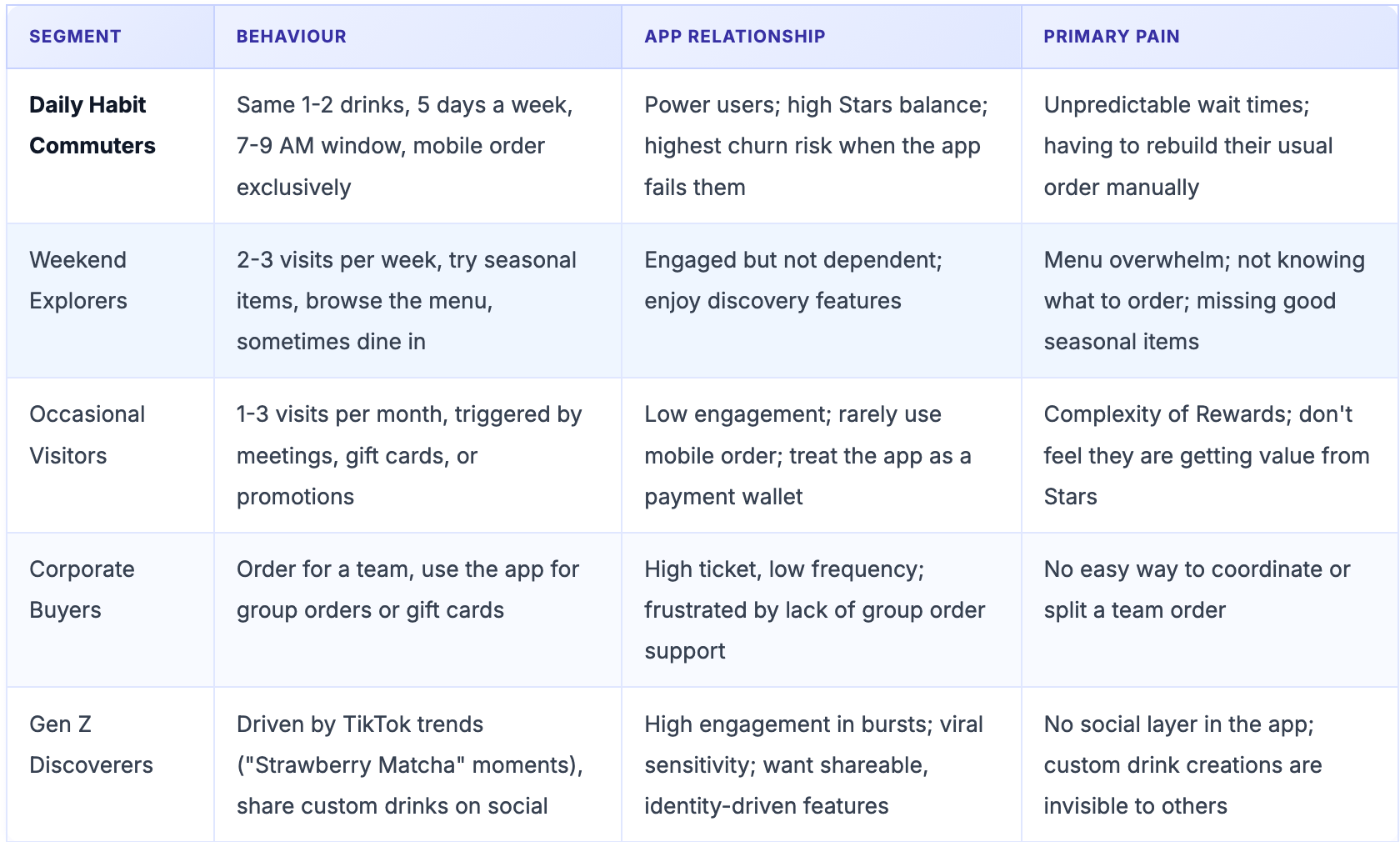
I am focusing on Daily Habit Commuters as the priority segment. They have the highest visit frequency (the single strongest predictor of lifetime value in QSR loyalty), they are already converted mobile-order users (so the activation cost is zero), and they are the most vocal source of negative reviews. Fixing the experience for this segment will yield the largest measurable improvement in the North Star metric in the shortest time.
Age range: 25-40
Use case: commute shortcut, not a social or discovery moment
Technology comfort: high; they have connected payment methods, notifications enabled, and location permissions granted
Emotional state when using the app: in a hurry; any friction is disproportionately annoying because they chose the app specifically to avoid friction
Persona: Vikram, 33, Software Engineer, Seattle. Vikram orders a venti cold brew with oat milk every weekday at 8:45 AM. He uses Mobile Order and Pay to skip the line at his regular store on the way to the office. He has 180 Stars but does not understand how to redeem them for his preferred drink. This week, his drink was ready on time 3 out of 5 days. On the other 2 days, he waited more than 12 minutes past the app’s estimated time. He checked the App Store and left a 2-star review that read: “Would be great if the wait time was even close to accurate.” He has not churned yet, but he is starting to wonder whether stopping to order at the counter might actually be faster.
Step 5: Map the Current Product and Diagnose Pain Points
What the Starbucks App Already Does Well: The app has an excellent onboarding flow that connects a Rewards account, payment method, and location in under two minutes. The customisation interface is best-in-class for a QSR app, allowing granular modifier selection that mirrors what a barista can actually make. The Challenges and Games system is effective at driving incremental visit frequency through time-limited bonus Star offers. The birthday reward is a genuine emotional touchpoint that customers mention positively in reviews. The overall visual design is polished and brand-consistent.
Central Gap: The app is optimised for placing an order, not for managing the customer’s relationship with time. Once an order is placed, the app provides almost no useful signal about what is happening in the physical world. The estimated wait time is calculated at the moment of order placement and is never updated. There is no real-time queue position, no notification when the barista starts the drink, and no proactive rebooking option if the store is overwhelmed. The customer’s only option after placing a mobile order is to show up and hope.
Pain Point 1: Unpredictable and Unupdated Wait Times. The estimated pickup time shown at checkout is a static snapshot based on average queue depth at the moment of order, not a live feed. Stores routinely get overwhelmed by simultaneous mobile orders during peak windows. Customers arrive to find 15 to 20 drinks queued ahead of theirs, with no notification that their original ETA was no longer valid. This is the number-one source of negative App Store reviews and the most direct failure of the mobile order value proposition.
Pain Point 2: Rebuilding the Same Order Every Day. Vikram wants his venti cold brew with oat milk. To place it via the app today, he opens the app, navigates to the menu, finds Cold Brew, selects the size, scrolls through modifiers, changes milk to oat milk, selects the store, and checks out: a minimum of 7-9 taps. There is a “favourites” feature, but it is buried in the profile section and is not surfaced contextually at the right moment. For a commuter in a hurry, this friction adds up over 260 working days a year.
Pain Point 3: Stars Redemption Confusion. Vikram has 180 Stars but does not know what he can redeem them for at his tier, how close he is to the next redemption level, or whether his preferred cold brew qualifies. The Stars balance is displayed prominently, but the redemption catalogue is hidden behind multiple taps and described in language that feels like terms and conditions rather than a reward. Members who cannot connect their Stars balance to a specific desired reward treat the programme as opaque and eventually stop caring about it.
Pain Point 4: No Social or Discovery Layer. Starbucks drinks are inherently social: custom creations go viral on TikTok, seasonal drinks generate enormous organic social content, and regulars at a specific store often develop informal community bonds. The app has no mechanism for capturing or amplifying this. There is no way to see what is trending at your specific store, no way to share a custom drink creation with a friend, and no community feature that reinforces the “third place” identity. This is a missed retention and acquisition opportunity, especially for the Gen Z Discoverer segment.
The root cause connecting all four pain points is the same: the app treats each transaction as an isolated event rather than as part of an ongoing, intelligent relationship between a known customer and a known store. Starbucks has the data to do much better. It knows Vikram’s usual order, his usual store, his usual time, and his Stars balance. It does not yet use that knowledge to proactively serve him.
Step 6: Propose Solutions
I am organising the solutions into three layers: a Fix the Core layer (high urgency, directly addresses the broken mobile order experience), a Personalise the Journey layer (medium urgency, makes the app feel like it knows you), and an Extend the Third Place layer (longer horizon, builds community and discovery into the digital experience).
