

How to Answer Product Improvement Questions?
Here is a step-by-step framework you should follow while answering product improvement interview questions during the interview,
1. Describe the Product. (P)
2. Ask clarifying Questions to trim down the scope of the question. (Q)
3. Define the Goal you want to achieve. (G)
4. List the User Segments and select one segment to focus on. (U)
5. List and prioritize the Pain Points for that segment. (P)
6. List out your Solutions to solve those pain points. (S)
7. Evaluate all the solutions and prioritize them. (E)
8. Define Metrics to measure the performance of the solutions. (M)
9. At the end, Summarize your answer (S)
Before the start of interview, write down these steps somewhere in case you forget.
Let’s get started with the solution (remember to follow the framework),
1. Describe the Product
Once you are clear with the question, start by explaining your understanding of the product. Cover the following things about the product,
What does the product do?
Who uses it?
How are they using it?
What pain point is it solving for the users?
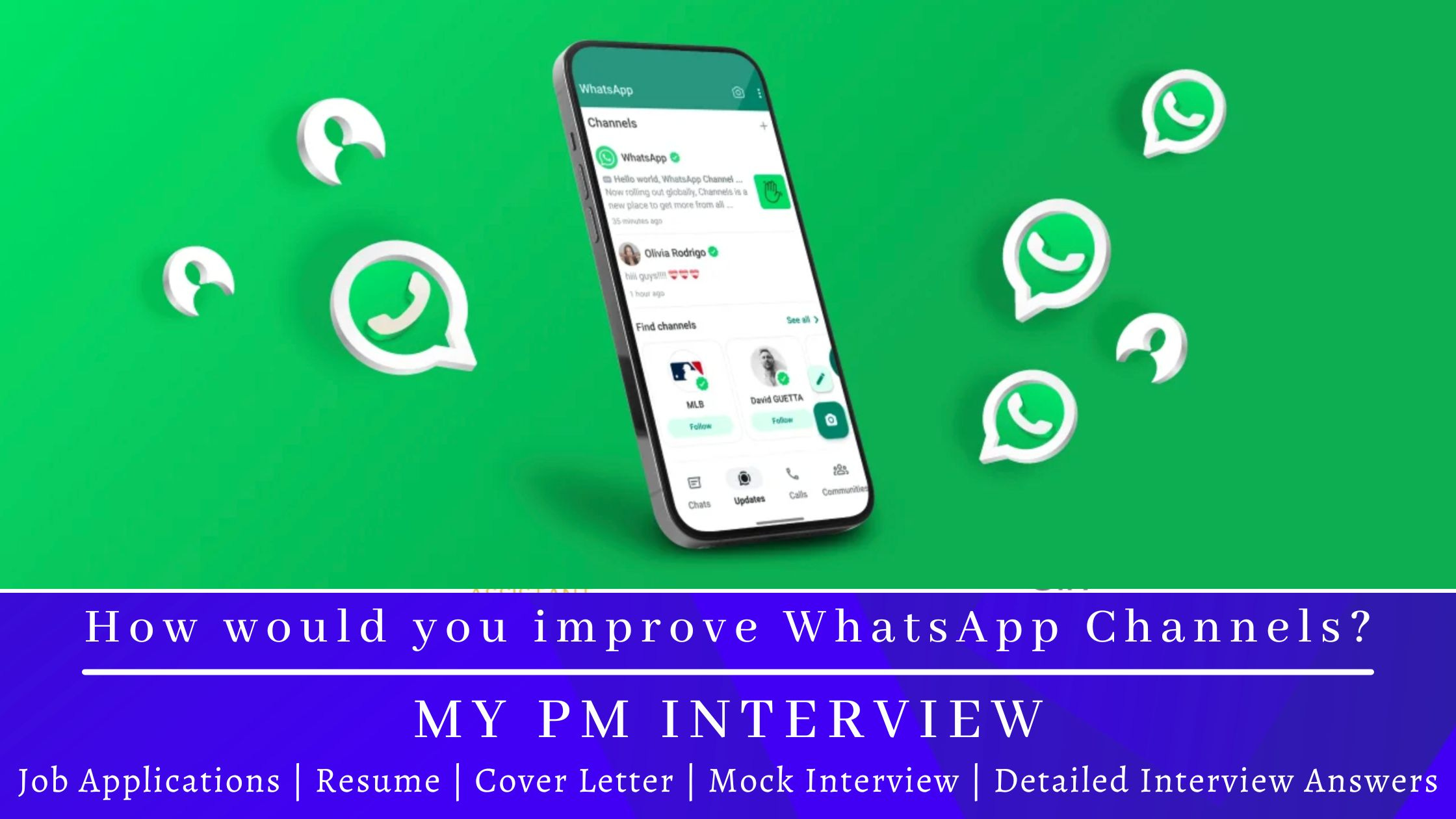
WhatsApp Channels are a one-way broadcast feature inside WhatsApp (separate from private chats) that lets people, creators, media and organizations publish updates (text, photos, video, stickers, polls) to followers. Channels live in the Updates area and are intentionally designed to be one-way (followers cannot post to the channel feed; they can react).
Who uses it: channel admins (creators, media outlets, brands, public officials) publish; followers (consumers) subscribe to receive updates. Verified/official accounts can get special markers.
How they use it: admins post scheduled or ad-hoc updates; followers view updates in a separate tab, react with emojis and follow invite links from chats or other channels. Posts are optimized for high-reach broadcast and (per some implementations) may have retention limits.
Pain it solves: gives organizations a private-by-design broadcast channel that keeps broadcasts separate from personal chats and avoids noisy two-way group dynamics; useful for announcements, news, and one-way updates.
Now that we are clear on the product description and the interviewer is also onboarded.
Let’s move on to the next step: Ask Clarifying Questions.
You: “Before we move on, I have a few clarifying questions I want to ask. Shall I proceed?”
2. Ask Clarifying Questions
Ask these at the start of a real interview (I’ll assume helpful default answers in parentheses so we can continue.)
Are we improving Channels for admins (creators/businesses), followers (consumers), or both?
(I’ll focus on Channel Admins / creators — highest leverage for engagement & monetization.)Geographic focus?
(Global)Constraint: preserve WhatsApp’s privacy/one-way ethos?
(Yes, keep Channels one-way by default)Should we assume limited engineering bandwidth (MVP in 1–2 quarters) or a long-term roadmap vision?
(Assume limit engineering bandwidth)Should we compare WhatsApp Channels with Telegram Channels, Instagram Broadcast Channels, or YouTube Community?
(Take competition features into consideration, too.)
3. Define the Goals
The mission of WhatsApp is to “connect the world privately by designing a product that is simple, reliable, and secure,” which aligns with Meta’s broader mission of bringing people and communities closer together.
With the introduction of WhatsApp Channels, the platform has expanded beyond private messaging into a broadcast and creator ecosystem. Channels allow creators, businesses, and organizations to share updates at scale while preserving user privacy and keeping personal conversations separate.
However, Channels is still an early-stage product with challenges around discoverability, engagement, and sustainable monetization for creators and businesses. Without solving these problems, creators may prefer competing platforms like Telegram, YouTube, or Instagram for distribution and revenue.
Therefore, the primary goals of improving WhatsApp Channels are to increase relevant follower growth through better discovery, drive deeper engagement with channel content (views, reactions, and sharing), enable safe and scalable monetization for channel admins, and maintain WhatsApp’s core privacy-first and one-way broadcast design while introducing optional, controlled interactions.
These improvements will help WhatsApp build a strong creator ecosystem, increase time spent in the Updates tab, and create long-term revenue opportunities for the platform.
4. User Segments
Segments relevant to Channels:
Channel Admins: Creators/Influencers (need reach, analytics, monetization).
Channel Admins: Businesses/Media (need scale, scheduling, compliance, API).
Followers: Casual users (discover content, want low-noise updates).
Followers: Power followers (paying subscribers, want extras like Q&A or exclusives).
Moderation/Policy teams (need tools to enforce content policy at scale).
Focus: Channel Admins: Creators & Small/Medium Businesses.
Reason: improvements here drive better content + monetization, which increases follower growth and platform health.
5. Pain Points for that Segment
Major pain points of the Channel Admins: Creators & Small/Medium Businesses user segments are,
