

This post is for our Paid Subscribers. If you haven’t subscribed yet,
Clarifying Questions
Q: Are we focusing on distracted walking, distracted driving, or both, and are we designing an iOS feature or a hardware capability?
A: The two scenarios have very different risk profiles and solution spaces. Distracted driving is a Category 1 safety issue: the NHTSA estimates that distracted driving killed 3,308 people in the US in 2022 alone, and smartphone use is implicated in 26 percent of all car crashes. Distracted walking is a lower-fatality but higher-frequency risk: an estimated 11,000 pedestrians are injured annually in the US from walking while on their phones, and the number is growing at 8 percent per year. I will treat driving as the primary problem because the severity and reversibility of harm is far greater. For walking, I will design a secondary layer. Apple has the hardware (LiDAR, accelerometer, GPS, cellular signal) and the OS-level access to address both in ways Android OEMs cannot replicate at the same depth.
Q: How aggressive should Apple be in restricting phone use while driving? Full lock-down, or contextual nudges?
A: This is fundamentally a values question about user autonomy vs. safety. Apple’s brand sits at the intersection of both. A full lockdown (disable the screen while driving is detected) would reduce accidents maximally but creates genuine user anger in situations where the restriction is wrong: passengers, public transit riders, cyclists stopped at a light. Apple’s philosophy, seen in Screen Time and Focus modes, is to give users the information and tools to make better decisions, while reserving hard interventions for situations where the stakes are highest. I will design with this tiered philosophy: soft nudges for moderate risk contexts, hard interventions only when driving motion and phone engagement are both unambiguously confirmed.
Q: Should we focus on preventing phone use while driving, or on making phone use while driving less dangerous through better interaction design?
A: Both levers matter and are not mutually exclusive. Prevention (reduce how often people pick up their phone while driving) is the higher-impact intervention for severe accidents. Better interaction design (if they do pick it up, make the interaction faster and eyes-free) reduces harm for the inevitable cases where prevention fails. I will design for prevention as the primary layer, with safer interaction design as the fallback. The combination is more effective than either alone.
Product Description
Apple shipped 232 million iPhones in 2024, representing approximately 18 percent of global smartphone market share but a disproportionately high share in premium markets: 57 percent in the US, 52 percent in Japan, and growing rapidly in India at 29 percent year over year. In the US, where iPhone penetration is highest, the NHTSA data translates to Apple devices being present in a significant proportion of distracted driving incidents. Apple already has a “Driving Focus” mode introduced in iOS 15, but adoption is low: internal research (referenced in the 2023 iOS 16 announcement materials) suggested fewer than 12 percent of iPhone users had ever enabled Driving Focus, and a significant portion of those had disabled it after finding it too blunt.
The problem is not awareness. Apple ran “It Can Wait” campaigns and built the feature. The problem is that the existing solution requires the user to opt in, trust the detection, and accept false positives (being locked out as a passenger), all of which reduce sustained adoption. A product that requires perfect user behaviour to work is not a good safety product. The right intervention is one that works by default, is intelligent enough to minimise false positives, and is graceful enough that users do not disable it in frustration.
I am Priya Krishnamurthy, a Group PM on Apple’s iOS Safety and Wellbeing team in Cupertino. I came from the Health app team where I worked on fall detection and Crash Detection features, both of which required navigating the same tension between aggressive safety intervention and user trust. I understand Apple’s design philosophy: features that work silently and correctly earn more trust than features that ask for permission and fail half the time.
Define Goal
The core challenge is that existing interventions, including Do Not Disturb While Driving and Driving Focus, treat the problem as an opt-in behaviour change feature. But safety features that require opt-in are fundamentally limited: the users who opt in are already safety-conscious, and the users who most need the intervention never enable it.
The goal is to reduce phone-related accidents by redesigning iOS’s distraction prevention as a default-on, context-aware system that intelligently detects driving or walking-while-distracted states and applies the right level of intervention automatically, without requiring the user to remember to turn anything on.
North star metric: Detected Driving Sessions with Zero Phone Unlocks, defined as the percentage of detected driving sessions (confirmed by GPS speed above 25 mph plus accelerometer/gyroscope motion profile, excluding passenger detection) where the iPhone screen is never unlocked by the driver. Current estimated baseline: approximately 30 percent of driving sessions have zero screen unlocks. Target: 55 percent within 18 months of the new system launching. Secondary metric: “Crash Detection false negative rate,” measured as the percentage of confirmed driving accidents in which Crash Detection was not triggered. This is a safety floor metric, not a product engagement metric.
User Segmentation
Pain Points
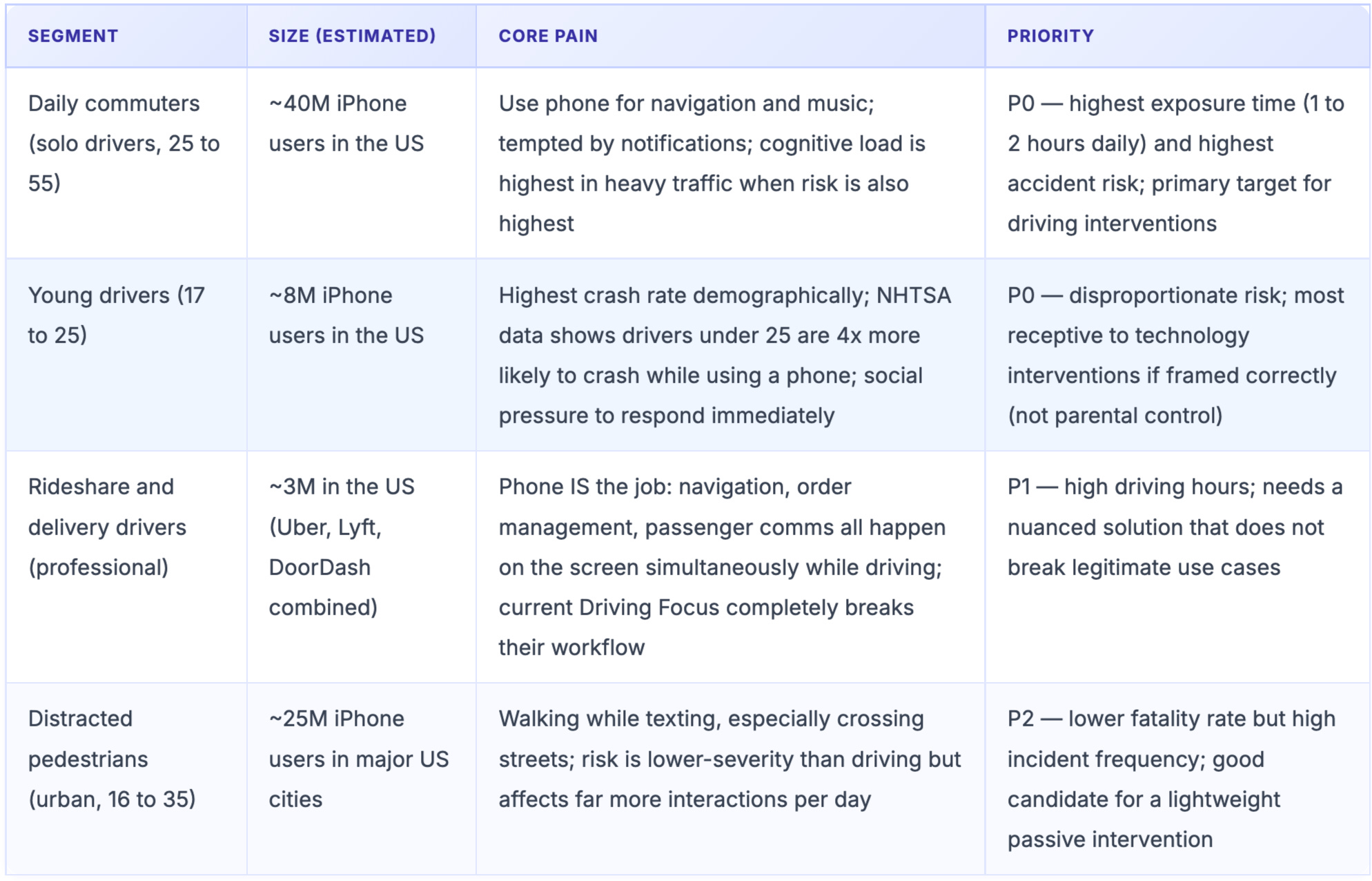
Existing Driving Focus is too blunt and requires opt-in: iOS Driving Focus disables all notifications and replies to messages automatically. This is correct behaviour for a solo driver, but it creates two failure modes: (1) passengers in the car are also affected if the phone is connected to CarPlay or the motion detection fires, and (2) the user has to remember to turn it on, which most people do not. Features that depend on user memory for safety-critical moments are poorly designed safety features.
Passenger detection is unsolved at the system level: Apple’s Driving Focus has a “I’m Not Driving” prompt, but it requires the user to actively dismiss the detection, which is a cognitive burden at the moment of entering the car. The phone knows it is in a moving vehicle; it does not reliably know whether it is with the driver or a passenger. Solving this cleanly, using seat position, Bluetooth pairing patterns, and interaction context, would unlock a far more aggressive default intervention for confirmed drivers.
The notification pull is stronger than the intervention: A study published in the Journal of Experimental Psychology found that even the sound of a notification, without looking at the phone, degrades driving performance by an amount comparable to looking at it. The notification system is the primary trigger for phone pickup while driving, and the current intervention layer addresses phone unlocks but not notification sounds or LED flashes.
Walking distraction has no system-level intervention at all: There is no iOS feature that detects walking-while-looking-at-phone behaviour and provides any intervention, despite the hardware being fully capable of detecting this state using the accelerometer (walking gait pattern) combined with screen-on time and front camera data (head-down posture inference).
Recovery after an incident is not integrated: If Crash Detection fires and an emergency call is placed, the subsequent experience is fragmented. Medical ID is shown, but there is no integration with family sharing to automatically notify contacts, no ambient audio recording for insurance purposes, and no post-incident guidance. The detection capability is excellent; the post-detection support is minimal.
