

Dear readers,
Thank you for being part of our growing community. Here’s what’s new this today,
AI Product Management Interview Question:
Your team has developed a new text-to-video model. If you were the PM responsible for bringing this to market, how would you approach productizing it?
Note: This post is for our Paid Subscribers, If you haven’t subscribed yet,
Before jumping into a go-to-market plan, a strong PM answer starts by demonstrating structured thinking through clarifying questions. These questions frame the scope of the problem, surface hidden constraints, and show the interviewer that you think before you build.
Key Clarifying Questions
What is the current maturity of the model? Can it produce production-grade 1080p clips of 10 seconds or more, or is it still at research-preview quality with artifacts and inconsistencies?
Does our company already operate in the creative or AI tooling space with existing distribution channels, or are we entering a new market from scratch?
Are there specific strategic goals driving this productization, such as revenue generation, market positioning, developer ecosystem growth, or data flywheel creation?
What compute and infrastructure budget do we have? Video generation is GPU-intensive, and serving costs will directly shape pricing and access models.
Are there legal or safety considerations around training data provenance, deepfake risk, or content moderation that we need to address before launch?
Assumption
We are a mid-to-large AI company with an existing platform (similar to a developer ecosystem or creative suite). The model produces near-cinematic quality text-to-video clips up to 15 seconds at 1080p resolution. We have meaningful but not unlimited GPU capacity. The goal is to capture early market share in the rapidly growing AI video generation market while building a sustainable business.
Market Landscape and Opportunity Sizing
The text-to-video AI market is one of the fastest-growing segments in generative AI. Understanding the competitive terrain and market dynamics is essential before making product decisions.
Market Size and Growth
• The global AI video generator market was valued at approximately $717 million to $788 million in 2025, depending on the source, and is projected to reach $3.4 billion by 2033 at a CAGR of roughly 20%.
• The text-to-video segment specifically is one of the fastest-growing sub-markets, projected to reach over $1 billion by 2029.
• AI-generated videos accounted for up to 35% of global digital video production in 2025, signaling that this technology has crossed from experimental to mainstream adoption.
• North America holds approximately 41% of global market share, with Asia-Pacific growing at the fastest rate of around 42% CAGR.
Competitive Landscape
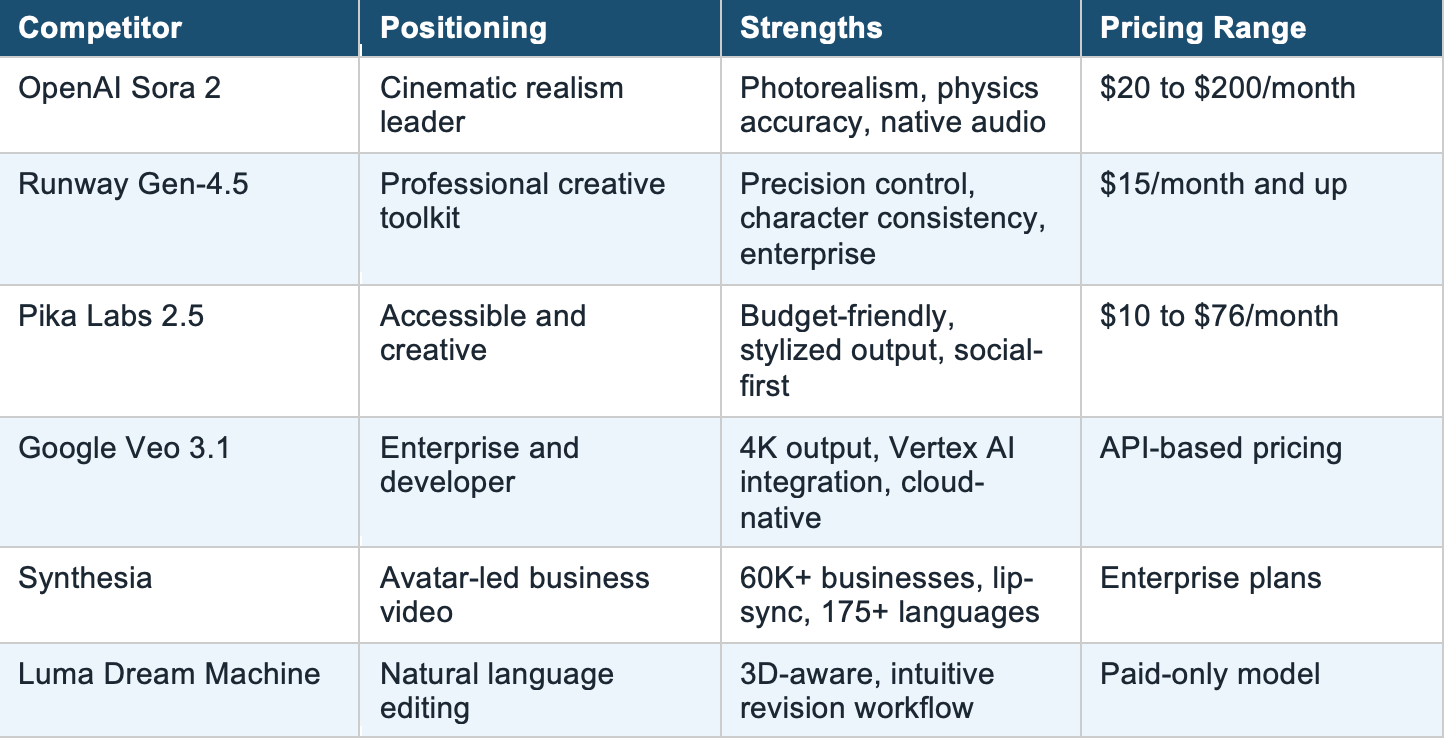
Key Market Insight
Quality alone is no longer a defensible moat. As generation capabilities approach parity across platforms, the competitive advantage is shifting to creative direction tools, workflow integration, character and brand consistency, and ecosystem lock-in. The winner will not just generate the best clip; it will own the end-to-end creative workflow.
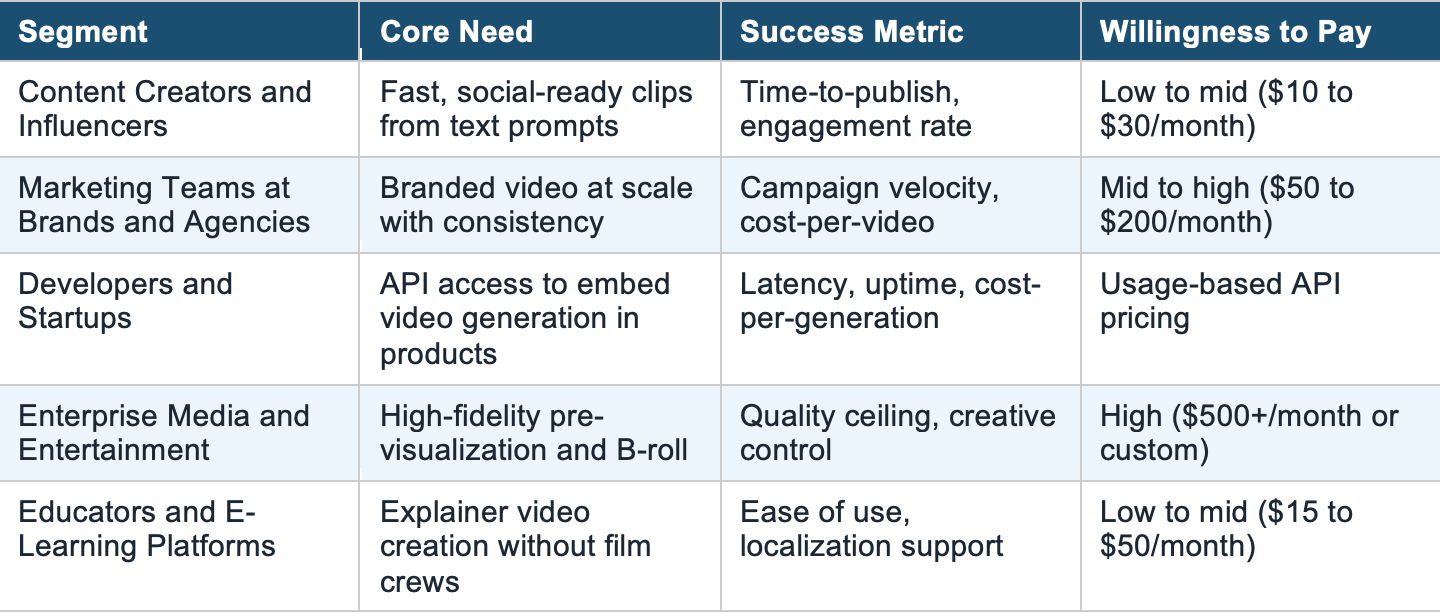
Target User Segments and Personas
Successful productization requires identifying distinct user segments with different needs, willingness to pay, and adoption patterns. A one-size-fits-all approach fails in a market this diverse.
Recommended Primary Target for Launch
Content Creators and Marketing Teams should be the primary launch audience. They represent the highest volume of demand, have clear willingness to pay, and generate public-facing content that serves as organic marketing for the platform. Developers and enterprise users can follow in a phased rollout with API access.
Product Vision and Core Value Proposition
The product vision should articulate not just what we build, but why it matters and how it differs from the competition.
Vision Statement
“Empower anyone to turn ideas into cinematic video in minutes, not weeks, with AI that understands story, brand, and craft.”
Core Value Propositions
• From Words to Worlds: Generate production-quality video clips from natural language prompts, with cinematic lighting, realistic motion, and coherent physics.
• Brand Consistency at Scale: Maintain consistent characters, settings, and brand elements across multiple scenes and campaigns, something most competitors still struggle with.
• Creative Direction, Not Just Generation: Provide precise control over camera movement, shot composition, lighting, and pacing through intuitive creative direction tools, not just a text box.
• Flexible Integration: Offer both a user-friendly web interface and a robust API, so the tool fits into existing workflows whether you are a solo creator or a platform builder.
Differentiation Strategy
Rather than competing solely on video quality (where diminishing returns are setting in), we differentiate on three axes:
1. Controllability and creative direction tools (camera paths, character libraries, style presets)
2. Workflow integration (plugins for existing editing software, API for developers, team collaboration features)
3. Trust and safety infrastructure (provenance watermarking, content moderation, transparent AI labeling)
Feature Prioritisation and MVP Definition
Using a RICE-style framework (Reach, Impact, Confidence, Effort), we prioritize features for launch versus future phases.
MVP Features (Launch Phase)
Text-to-Video Generation: Core text prompt input with style and mood selectors
Multi-Format Output: Landscape (16:9) and vertical (9:16) outputs at 1080p, reflecting the reality that 52.8% of AI video is landscape and 43.7% is vertical
Duration and Quality Controls: 5-second and 15-second clip options with quality settings
Style Presets Library: Pre-built visual styles (cinematic, animated, corporate, social-first)
Project Workspace: Simple project management with generation history and re-prompting
Content Provenance: C2PA-compliant metadata and visible watermarking on free-tier outputs
Phase 2 Features (Months 3 to 6)
RESTful API with per-generation pricing for developers and startups
Image-to-video conversion (a strong emerging use case, representing 32.6% of orders on some platforms)
Persistent character and setting libraries for brand consistency across scenes
Camera path controls and motion direction tools for professional creators
Team collaboration features with shared workspaces and approval workflows
Phase 3 Features (Months 6 to 12)
Native audio generation with synchronized dialogue and sound effects
Integration plugins for Adobe Premiere Pro, DaVinci Resolve, and Final Cut Pro
Enterprise deployment options with SSO, custom model fine-tuning, and on-premises inference
Multi-scene storyboarding with narrative arc support
Localization engine for multi-language video generation
Go-to-Market Strategy
The GTM strategy should sequence launch activities to build momentum, learn from early users, and scale efficiently.
