

Dear readers,
Thank you for being part of our growing community. Here’s what’s new this today,
Program Management / Chief of Staff Interview:
Understanding Leadership Styles and Operating Your Function Accordingly
Note: This post is for our Paid Subscribers, If you haven’t subscribed yet,

Great execution isn’t just about having the right strategy.
It’s about knowing who you’re executing for.
Two leaders can share the same goals and still require entirely different operating models. One wants weekly dashboards. Another wants narrative memos. One thrives in debate. Another shuts down when challenged publicly.
Teams often struggle not because the work is wrong, but because it’s being delivered in a way the leader cannot process, trust, or act on.
Understanding leadership styles is not politics.
It is operational intelligence.
The strongest operators don’t just manage work.
They manage how leadership thinks, decides, and engages.
What you’ll learn from this post
Leadership Styles
The Operator’s Job
The Visionary Leader
The Operator Leader
The Analytical Leader
The Intuitive Leader
The Consensus-Driven Leader
The Directive Leader
Hybrids Leaders
Aligning Strategy to Leadership Style
Why Leadership Style Shapes Execution More Than Strategy
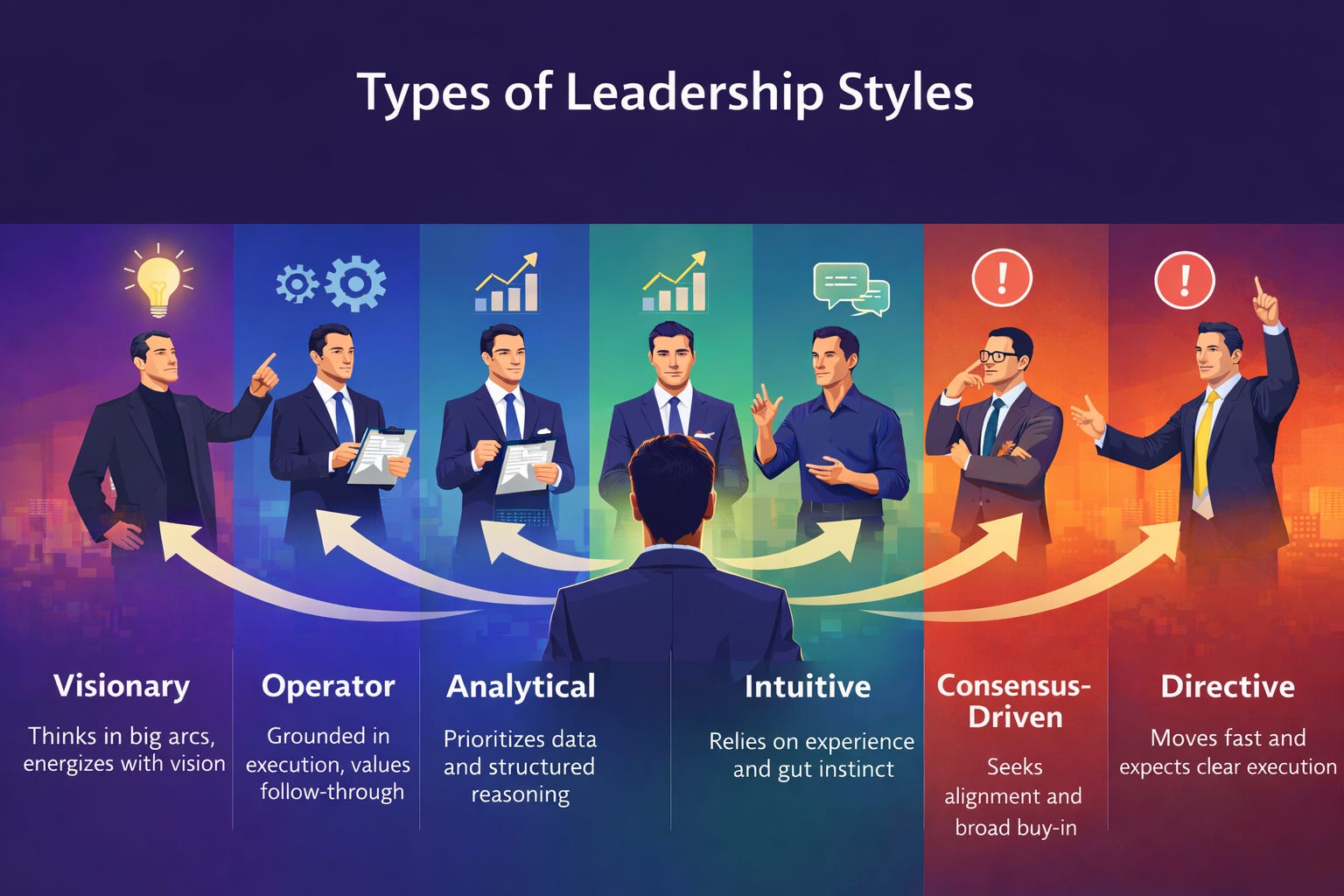
Leadership style determines:
How decisions are made
What information is trusted
How risk is evaluated
Where accountability truly sits
If you ignore this, even great strategy will stall.
If you understand it, you can:
Anticipate objections before they surface
Frame tradeoffs in ways that unlock decisions
Adjust planning, cadence, and communication for maximum leverage
This is especially critical for Chiefs of Staff, PMs, and senior operators whose success depends on influence rather than authority.
The Operator’s Job
Most leaders are not inconsistent.
They are consistent within their own operating logic.
Your job is not to change their style.
Your job is to translate your function and strategy into a shape that works with it.
Below are common leadership archetypes, how they operate, and how to adapt your execution model to each.
The Visionary Leader

How They Operate
Visionary leaders think in big arcs. They care deeply about direction, narrative, and long-term impact. They are energized by possibility and often impatient with detail.
They ask questions like:
Where is this going?
Does this move us closer to the future we want?
Why does this matter now?
Where Teams Struggle
Lack of clarity on near-term priorities
Frequent pivots without operational grounding
Frustration around changing goals
How to Operate Effectively
Anchor execution to the vision explicitly: always connect tasks to the bigger picture
Translate vision into a small set of concrete priorities
Actively manage scope creep by framing tradeoffs in terms of vision impact
For visionaries, context creates alignment, not detail.
