

Dear readers,
Thank you for being part of our growing community. Here’s what’s new this today,
Product Management Interview Question:
Q: Netflix plans to launch a new ad-supported feature. How would you roll it out and test its impact?
Note: This post is for our Paid Subscribers, If you haven’t subscribed yet,
Step 1: Clarify the Rollout Context
Before designing anything, I want to align on what we are launching, who we are launching it to, and what success looks like.
Q: When you say “ad-supported feature,” are we talking about a brand new ad-supported subscription tier, or a new ad format inside the existing ad-supported tier that Netflix launched in November 2022?
Let us assume it is a new ad format inside the existing ad-supported tier. The tier itself has been live for over three years and now reaches 190 million monthly active viewers globally.
Q: Which specific format are we launching? Netflix announced several at its 2025 upfront: AI-powered interactive midroll ads, pause ads with shoppable overlays, dynamic ad insertion, and four new advanced targeting capabilities. Which one should I ground the answer in?
Pick one and go deep. Strategic depth comes from a specific feature, not a generic “ads” answer.
Q: I will assume we are launching the Interactive Pause Ad with Shoppable Overlays. When a viewer pauses content, an AI-generated ad appears that matches the show’s visual world, with a clickable overlay, a QR code, and a second-screen call-to-action. This is one of the formats Netflix announced for global rollout in Q2 2026.
Q: Which markets are in scope first?
Start with the United States and Canada. That is where Netflix has been testing interactive video ads, where the ad tier has the deepest scale (45% of US households are now on the ad tier as of late 2025), and where advertiser sophistication is highest.
Q: What is the primary business goal of this launch?
Increase incremental revenue per ad-tier viewer (rIRPV) without degrading ad-tier engagement, retention, or advertiser confidence in Netflix as a brand-safe environment. Ads that earn more dollars but kill the platform are not a win.
Q: What are the hard constraints I should respect?
Stay within the current ad load (4 to 5 minutes per hour). Maintain the current ad-tier price point. Do not break advertiser brand-safety guarantees. Comply with regional privacy regulations (GDPR in Europe, CCPA in California, DPDP Act once we launch in India). Limit the AI creative pipeline to contextual personalization in v1, not behavioral.
Q: Is the ad-free tier untouched in this launch?
Yes. Premium and Standard ad-free subscribers see no change. Pause ads only appear on the ad-supported tier.
Locked-in scope for this answer
Feature: Interactive Pause Ad with Shoppable Overlays, AI-personalized to scene context
Markets in Phase 1 to 3: United States and Canada
User: Existing ad-tier viewers
Primary goal: Lift incremental revenue per ad-tier viewer by at least 8 to 12 percent
Constraints: No ad load increase, no price change, no behavioral targeting in v1, brand safety must remain at current standard
Step 2: Company Strategy
Before I design the rollout, I want to anchor the launch in why Netflix cares about this feature at all. A rollout plan disconnected from strategic intent is a project plan, not a product strategy.
Netflix’s strategic position in early 2026
Netflix has more than 300 million paid memberships globally. The ad-supported tier reached 190 million monthly active viewers by late 2025, up from 94 million in May 2025. More than 60 percent of new sign-ups in markets where the ad tier is available now choose it over the ad-free option. Ad revenue is on track to roughly double from 1.5 billion dollars in 2025 to 3 billion dollars in 2026. Netflix has fully transitioned from the original Microsoft ad-tech partnership to its own in-house ad platform, and programmatic now accounts for nearly half of non-live ad business. The advertiser base has crossed 4,000 brands, growing 70 percent year-over-year.
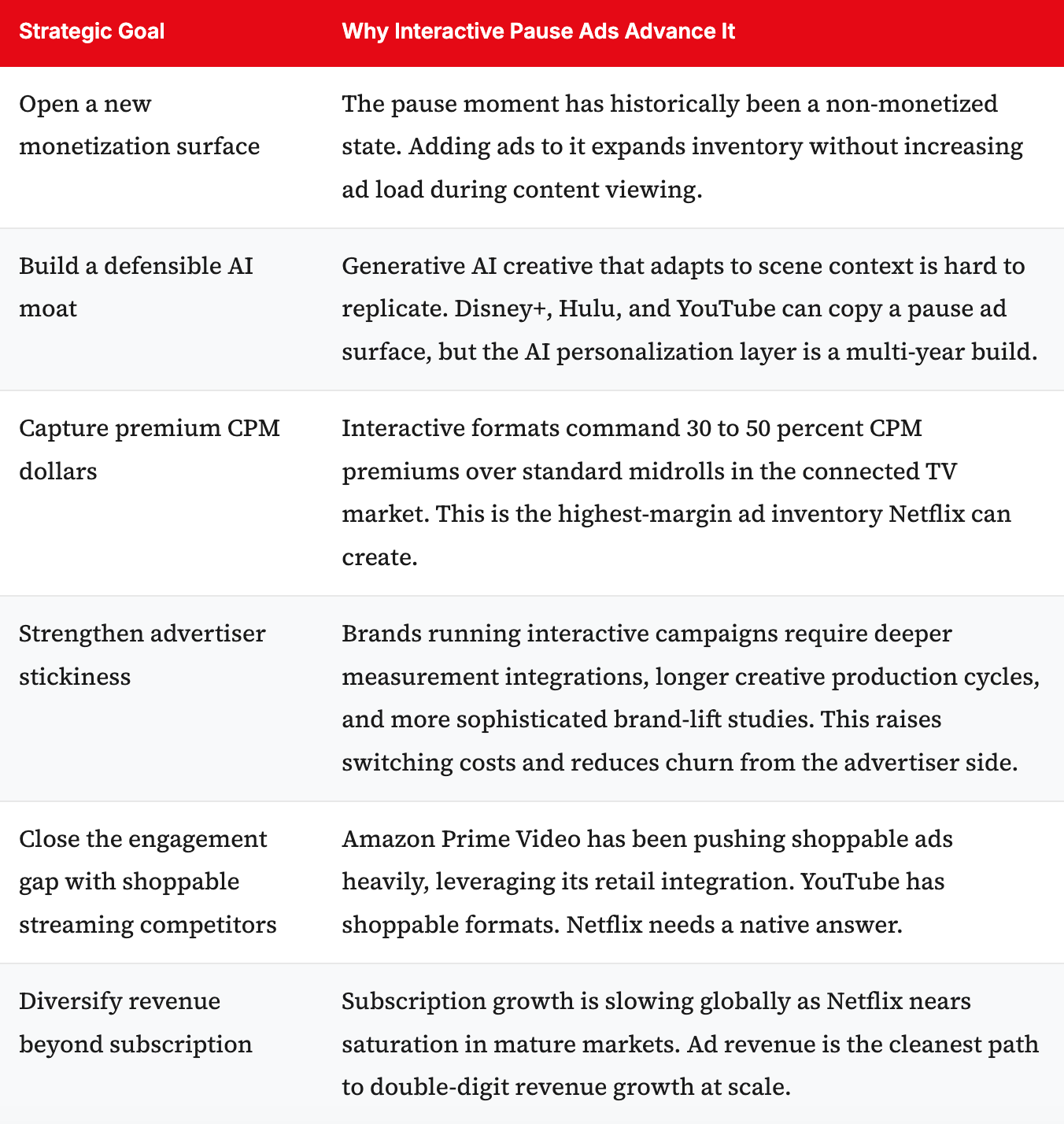
Why interactive pause ads matter to Netflix strategically
Why is this a defensive play, not just an offensive one
It is tempting to frame this as Netflix going on the offensive. The honest read is more nuanced. Interactive pause ads are also a defensive bet against three forces. First, advertiser dollars are migrating from linear TV to connected TV faster than connected TV inventory is scaling. Without new formats, Netflix would leave money on the table that flows to YouTube, Amazon, and the broader DSP ecosystem. Second, viewer attention during content is finite, but viewer attention during pause is structurally different and currently un-monetized. Third, AI-generated creative is the direction the entire ad industry is heading. If Netflix does not build the format internally, it eventually has to license the capability from a third party, which compresses margin and reduces strategic control.
Step 3: User Segmentation and Prioritization
Netflix is a two-sided platform on the ad tier. There are viewers consuming content, and there are advertisers buying inventory. A rollout plan that only segments one side is incomplete. I will segment both.
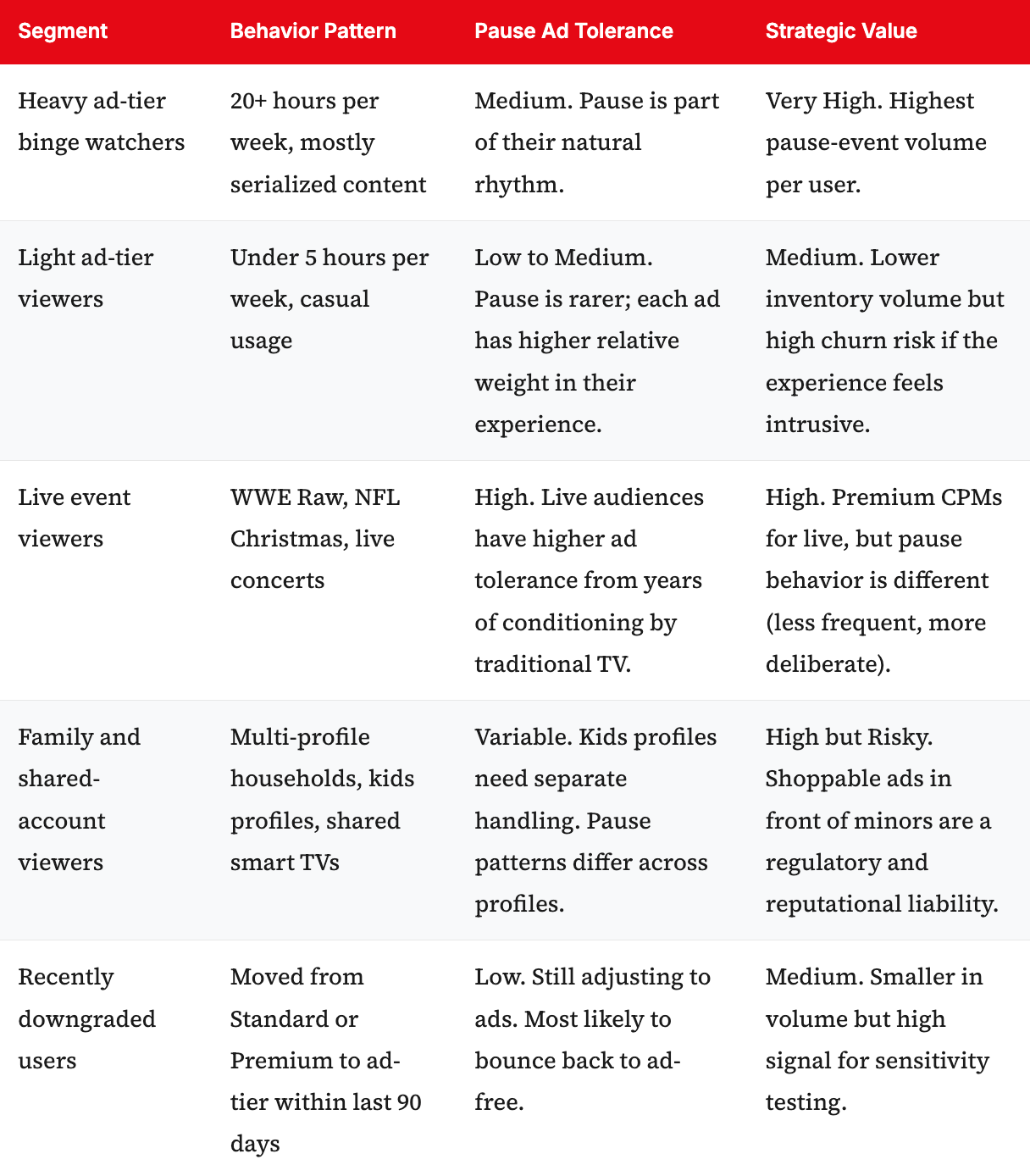
Viewer-side segments
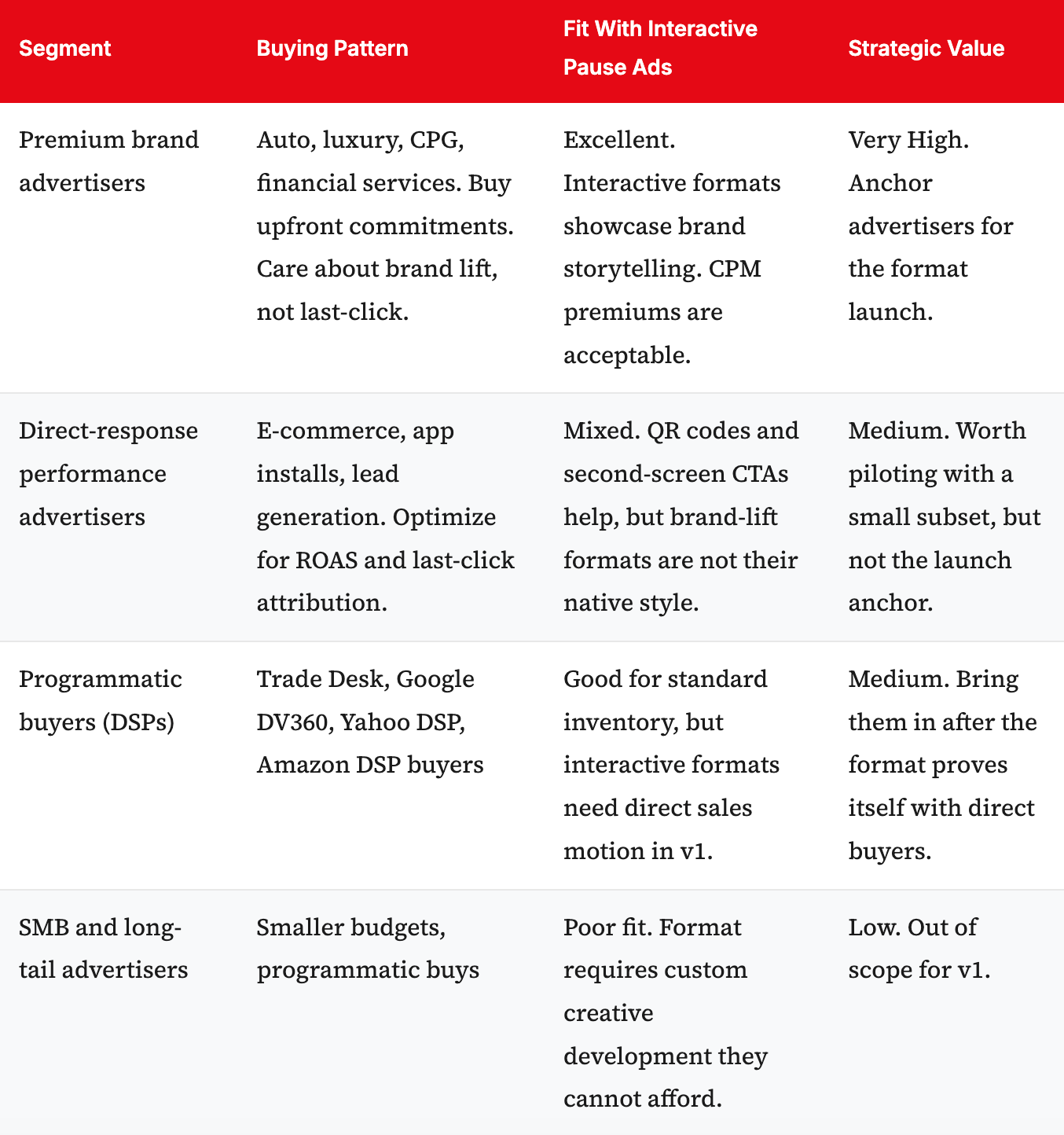
Advertiser-side segments
Prioritized segments for the launch
Viewer side: Heavy ad-tier binge watchers. Highest pause-event volume per user means richer experimental signal in less time. Most established ad tolerance. Largest ARPU upside. Recently downgraded users are deliberately deprioritized in v1 because they are the most likely to churn and would contaminate the retention signal.
Advertiser side: Premium brand advertisers. Anchor advertisers must be sophisticated enough to evaluate the format on attribution and brand-lift terms, not last-click ROAS. The wrong launch advertisers will declare the format a failure on their own narrow metric and pull confidence. Start with 8 to 12 brands across auto, luxury, financial services, and premium CPG.
Deliberately deprioritized: Kids profiles entirely (regulatory liability), recently downgraded users (retention contamination), and direct-response performance advertisers (wrong attribution model). These are not bad segments. They are the wrong segments to anchor a v1 launch.
Step 4: Phased Rollout Strategy
I would not launch this globally on day one, even though Netflix announced a global Q2 2026 timeline at its upfront. The internal rollout plan should be more cautious than the external commitment. I will use four phases, each answering a distinct learning question.
Phase 1: Internal Alpha (2 weeks)
Goal: Technical validation. We are checking that pause ads render correctly across device types (smart TVs, mobile, web, game consoles), do not introduce playback latency when resuming, do not break the pause-and-resume flow, and that the AI creative generation pipeline produces brand-safe outputs every single time.
Population: Netflix employees only.
What we test: ad insertion latency, video buffering on resume, fill rates across creatives, render quality of overlays and QR codes, second-screen handoff, AI creative pipeline output review.
Success criteria: No meaningful increase in playback failures, pause-to-ad-render latency under 600 milliseconds, 100 percent brand-safety pass rate on AI-generated creatives in human review.
Exit gate: All success criteria met for two consecutive weeks. No statistical claims at this stage.
Phase 2: Closed Beta (4 weeks)
