

This post is for our Paid Subscribers. If you haven’t subscribed yet,
Step 1: Ask Clarifying Questions
Before diving in, I want to align on scope before forming a view on this product decision.
Q: Are we talking about the initial onboarding flow for brand-new Facebook accounts, or also prompts shown to existing users who skipped the photo earlier?
I will assume we are focused on the new-user onboarding flow. Existing users who skipped have already formed habits; the friction of onboarding is where the drop-off and trust cost is highest, and that is where changing the policy has the most impact.
Q: When we say “mandatory,” do we mean the user cannot proceed without uploading, or that the prompt appears but has a visible skip option that most users overlook?
I will assume it is a hard gate: users cannot complete signup without uploading or taking a photo. If it were a soft nudge, this would be a simpler UX fix. A hard gate is a deliberate product choice worth debating on its merits.
Q: Are we optimising for new-user activation rate, long-term retention, or advertiser targeting quality?
I will treat new-user activation rate (completing registration and posting a first action within 7 days) as the primary goal, because that is where a mandatory photo gate creates the highest measurable friction. Advertiser quality is a secondary constraint, not the objective function here.
Q: Are we considering all markets globally or a specific geography like India, where smartphone cameras vary widely and data privacy concerns are acute?
I will scope my analysis to India as a representative market, since Facebook has over 400 million monthly active users there, onboarding happens disproportionately on low-cost Android devices with weak front cameras, and privacy sensitivity is rising sharply post the 2021 IT Rules. The findings generalise to other emerging markets with similar dynamics.
Q: Is there a specific safety or trust reason Facebook has kept this gate, such as reducing fake accounts or improving ad targeting quality?
I will assume yes -- the mandatory profile photo was designed partly to reduce bot and fake account creation, since real humans are more willing to upload a photo than bot operators. I will keep this as an explicit constraint when evaluating the options.
These clarifying questions matter because “should we remove this feature” is never a binary decision in product. The real question is: what problem is the current design solving, who does it hurt, who does it help, and is there a better way to achieve the same outcome? Getting those boundaries clear before opining prevents the classic mistake of treating a policy question as if it were purely a UX question.
Step 2: Understand the Product Context
Facebook’s onboarding funnel is one of the most studied and iterated flows in consumer tech history. The platform crossed 1 billion users in 2012 and now has approximately 3.29 billion daily active people across the Meta family of apps as of Q1 2024. In India specifically, Facebook had over 400 million monthly active users as of 2023 -- the largest single country audience on the platform -- and the majority of new users onboard via mobile, often on entry-level Android devices costing under 8,000 rupees.
Profile completeness has always been a Facebook North Star metric for a concrete reason: users with complete profiles are significantly more likely to return after Day 1. Internal Facebook research from 2016 (publicly disclosed in press interviews by former growth VP Alex Schultz) showed that users who performed 10 specific actions in their first 7 days had dramatically higher 6-month retention. A profile photo was one of those 10 actions, because it signals social identity investment. The photo makes the user feel “real” on the platform, encourages friends to connect, and triggers social notifications that pull the new user back.
At the same time, the mandatory photo gate creates documented friction. Research from onboarding specialists like Intercom and usability studies on social platforms consistently show that any mandatory field that requires an action outside the keyboard (camera access, file upload, permission prompt) creates a meaningful drop in funnel completion. The magnitude typically ranges from 5 to 15 percent funnel abandonment depending on platform and user cohort. For Facebook with hundreds of millions of new-user attempts per year, even a 1 percent funnel improvement represents millions of users.
The fake-account dimension is also real. Facebook’s own transparency reports show they take down approximately 1.3 billion fake accounts per quarter. Requiring a photo raises the cost of creating fake or bot accounts because it requires either a real photo (risky for bad actors) or a sourced/generated image (additional effort). Removing the gate without a replacement signal could meaningfully increase fake account volume and harm the trust ecosystem that underpins Facebook’s ad business, which generated 117 billion USD in 2023.
Step 3: Define the Goal and What Success Looks Like
The core tension in this decision is between two legitimate Facebook goals that are temporarily in conflict:
Goal A: Maximise new-user activation -- Get more people through the onboarding funnel and into their first meaningful social action within 7 days. The mandatory photo gate is a friction point that costs activations.
Goal B: Protect platform trust and ad quality -- Ensure new profiles represent real humans, which underpins ad targeting quality, social graph integrity, and safety. The mandatory photo gate is a verification signal that deters bots.
My chosen goal for this analysis: Maximise new-user activation rate (Day 7 return visit) while keeping fake account creation rate below its current baseline. This framing acknowledges that simply removing the gate without a replacement mechanism is not a valid option -- it would solve the UX problem while creating a trust problem. The right answer is a design choice that reduces friction without sacrificing trust signals.
North Star Metric: 7-day activated users (users who complete signup AND perform at least one social action -- like, comment, post, or friend request -- within their first 7 days), measured as a percentage of signups initiated. Currently estimated to sit between 60 and 70 percent based on industry norms for social platforms; the goal is to lift it by 5 to 10 percentage points.
Step 4: Who Are the Users Affected?
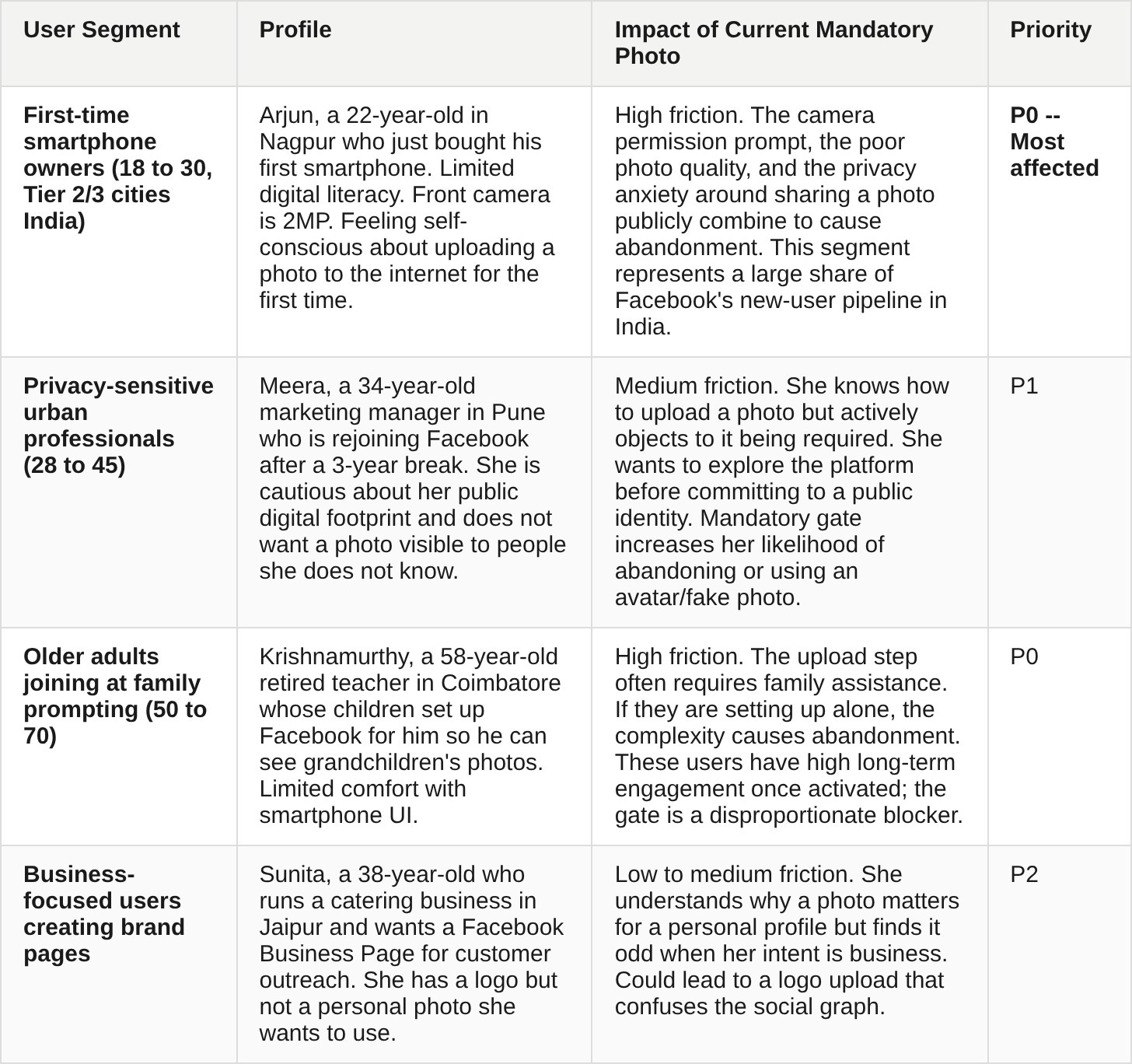
The two segments I will focus on are first-time smartphone owners and older adults joining at family prompting. They represent the highest volume of new signups in Facebook’s current growth markets (India, Indonesia, Nigeria, Brazil) and they face the highest friction from the mandatory photo gate. Solving for them likely captures 60 to 70 percent of the funnel abandonment problem.
