

Dear readers,
Thank you for being part of our growing community. Here’s what’s new this today,
Product Management - Behavioral Interview Question: Tell Me About a Time You Made a Risky Product Bet
Note: This post is for our Paid Subscribers, If you haven’t subscribed yet,
Why Interviewers Ask This Question?
This question is designed to evaluate several core PM competencies simultaneously. Interviewers want to understand how you think about risk, how you make decisions under uncertainty, and whether you can rally a team around a bold direction. It also reveals your ability to handle failure gracefully or capitalize on success strategically.
What are they really evaluating?
Strategic thinking: Can you identify asymmetric opportunities?
Decision-making under ambiguity: How do you act with incomplete data?
Stakeholder management: Can you get buy-in for unconventional ideas?
Ownership and accountability: Do you own outcomes, both good and bad?
Learning orientation: What did you extract from the experience?
Recommended Framework: STAR + Risk Matrix
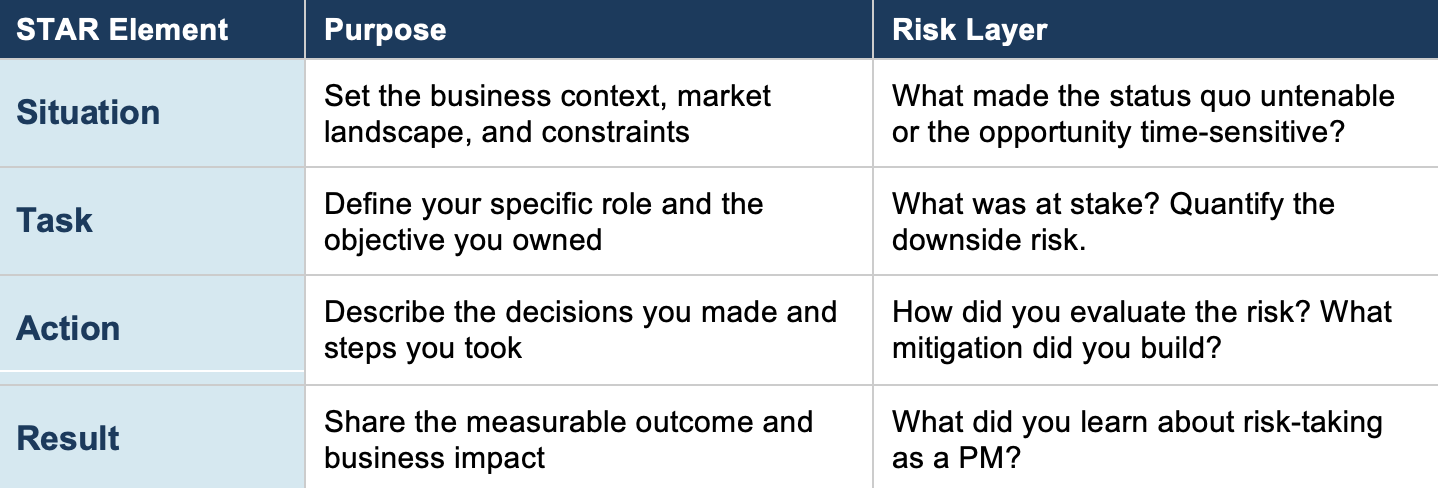
The most effective way to structure your answer is the STAR framework (Situation, Task, Action, Result) enhanced with a Risk Matrix overlay that explicitly shows how you identified, evaluated, and mitigated risk. This combination gives your answer both narrative clarity and analytical depth.
Answer
Situation
I was a Senior PM at a B2B SaaS company that provided analytics dashboards to mid-market e-commerce brands. Our core product had been growing steadily at about 15% year-over-year, but we were beginning to lose competitive deals to newer platforms that offered AI-powered predictive insights. Our churn among enterprise-adjacent accounts had crept from 8% to 14% over two quarters, and customer interviews made it clear: customers did not just want to see what happened; they wanted to know what would happen next.
Risk Context
The company had never shipped a machine learning feature. Our data infrastructure was not built for real-time prediction. Investing in this direction meant pulling two senior engineers off revenue-generating maintenance work for at least one full quarter.
Task
I was tasked with reversing the churn trend and finding a path to re-accelerate growth beyond 15%. The safe play would have been incremental: improve onboarding, add more chart types, polish the mobile experience. Instead, I proposed that we build a predictive analytics module that would forecast revenue trends and flag at-risk customer cohorts for our users’ businesses. This was the risky bet. If it failed, we would lose a quarter of engineering capacity with nothing to show for it, and our churn problem would worsen.
Action
I structured my approach around three phases to manage the risk deliberately:
