

Dear readers,
Thank you for being part of our growing community. Here’s what’s new this today,
Program Management / Chief of Staff :
Where Strategy Breaks or Ships
Note: This post is for our Paid Subscribers, If you haven’t subscribed yet,
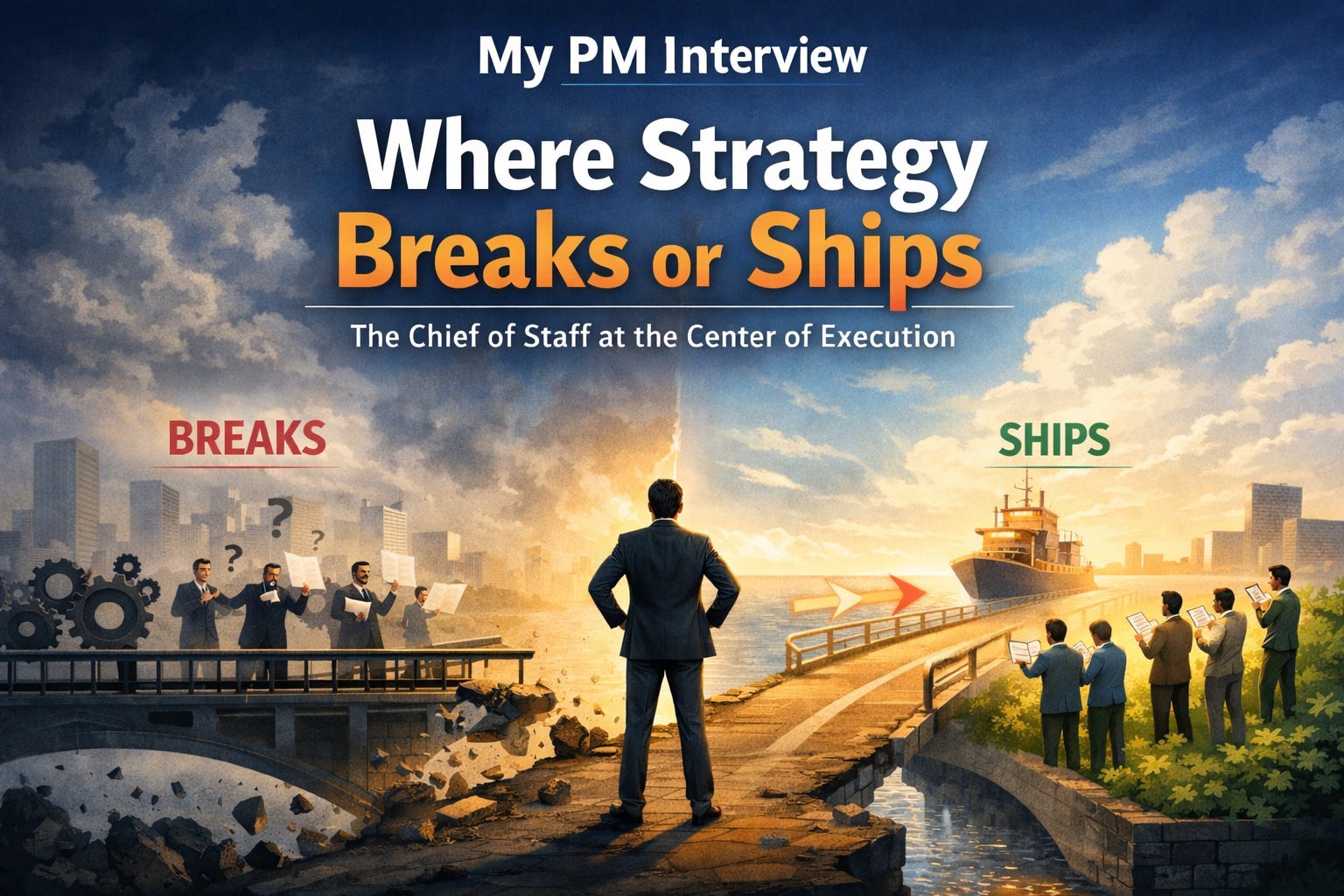
Most strategies don’t fail because they’re wrong.
They fail because they never fully land.
Leadership teams spend significant time crafting direction. Offsites, decks, frameworks, and bold narratives are rarely the problem. The real failure happens later, quietly, when that strategy begins its journey through the organization.
Somewhere between the executive room and the operating floor, intent gets diluted.
This is where momentum is lost.
This is where priorities blur.
This is where execution slowly degrades without anyone explicitly choosing failure.
That gap is not accidental. It is structural.
And it is precisely the gap the Chief of Staff role exists to manage.
Not as a fixer of last resort.
Not as administrative support.
But as the function that sits at the exact point where strategy either ships or breaks.
What you’ll learn from this post
Strategy Rarely Fails at the Whiteboard
The Chief of Staff as the Execution Anchor
Where Strategy Commonly Breaks
What Chiefs of Staff Actually Do at the Centre of Execution
Influence Without Authority Is the Job
Why This Role Is Increasingly Necessary
Real Measure of Success
Strategy Rarely Fails at the Whiteboard

At the leadership level, strategy discussions are usually thoughtful, rigorous, and well-intentioned. The problems don’t show up in the plan itself.
They show up in what happens after.
You see them as:
Decisions that felt crystal clear in the room but become ambiguous once shared downstream
Initiatives that technically launch but never achieve meaningful pull or adoption
Teams executing excellent local work that fails to add up to a coherent whole
Leaders surprised by outcomes that were implicitly approved weeks earlier
None of these are strategy failures.
They are failures of translation, alignment, and sustained attention.
In other words, execution failures.
And execution is not about doing more work. It is about ensuring the right work happens in the right way over time.
The Chief of Staff as the Execution Anchor

The cleanest way to understand the Chief of Staff role is this:
The Chief of Staff owns the space between intent and reality.
They are accountable for making sure that what leadership meant actually becomes what the organization does.
This includes ensuring that:
Strategic priorities translate into coherent, sequenced action
Decisions are truly understood, not just announced or documented
Tradeoffs remain explicit as execution unfolds
The organization doesn’t drift simply because leadership attention moves on
Unlike functional leaders, the Chief of Staff does not own a vertical.
They own outcomes that span multiple verticals.
Their work is horizontal, connective, and inherently integrative.
